






-
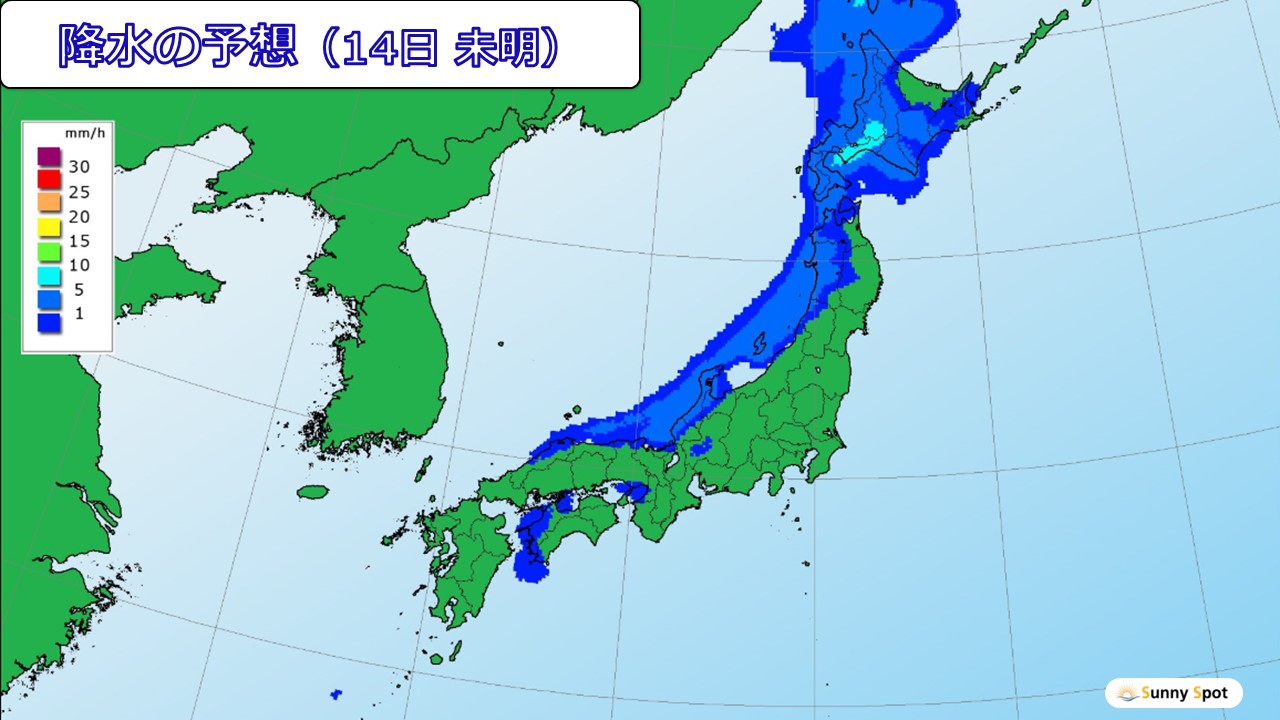
Low-pressure system to form over the Sea of Japan; widespread rain expected on the 14th, with a risk of heavy rain in Hokkaido.
2026/10/12 12:05
-
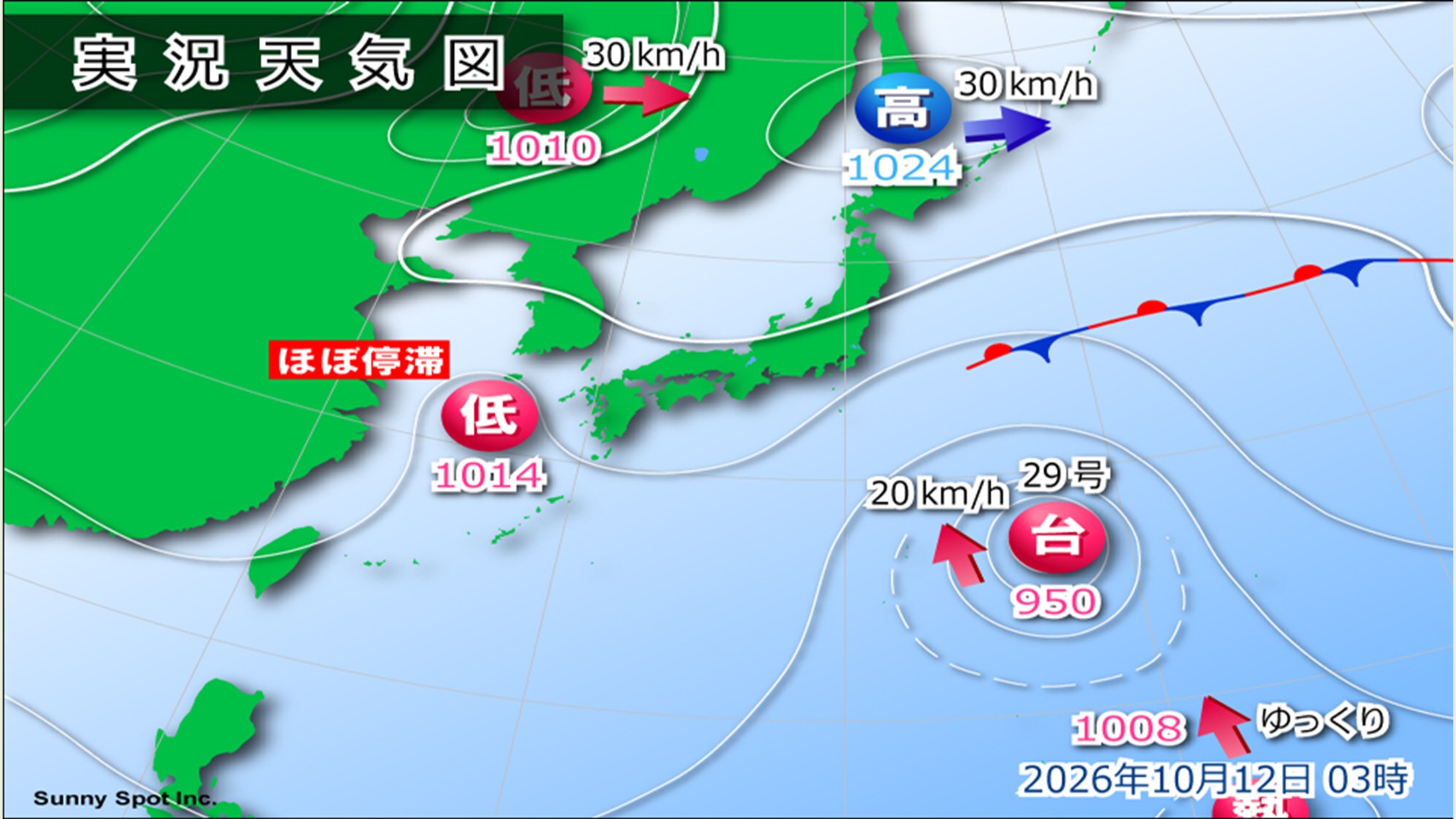
Today, Monday the 12th (a public holiday), a low-pressure system centered near Sakhalin is extending its influence toward Honshu and the waters south of Japan.
Due to a stationary low-pressure system near the East China Sea, rain is falling in the Okinawa and Amami regions, with some observations of moderately heavy rain accompanied by thunder.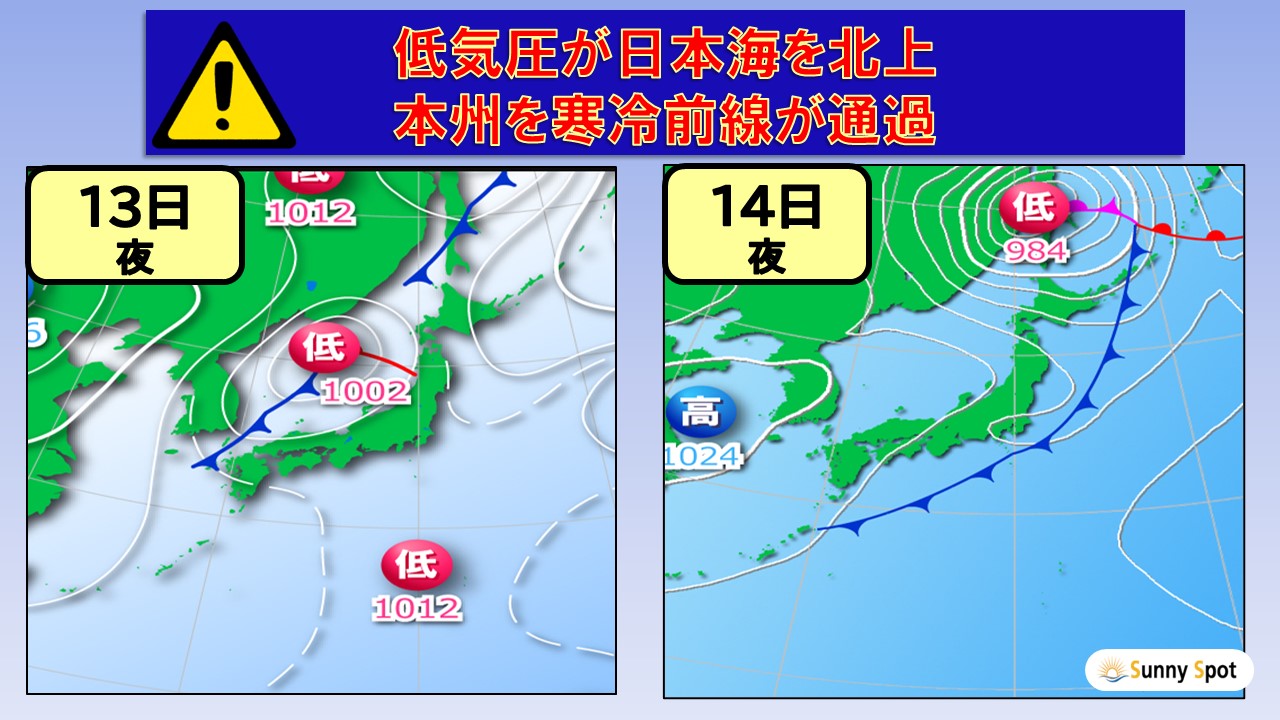
The low-pressure system in the East China Sea is expected to dissipate by tomorrow, Tuesday the 13th. Meanwhile, a new low-pressure system is expected to form over the Sea of ??Japan and move northeastward, accompanied by a front.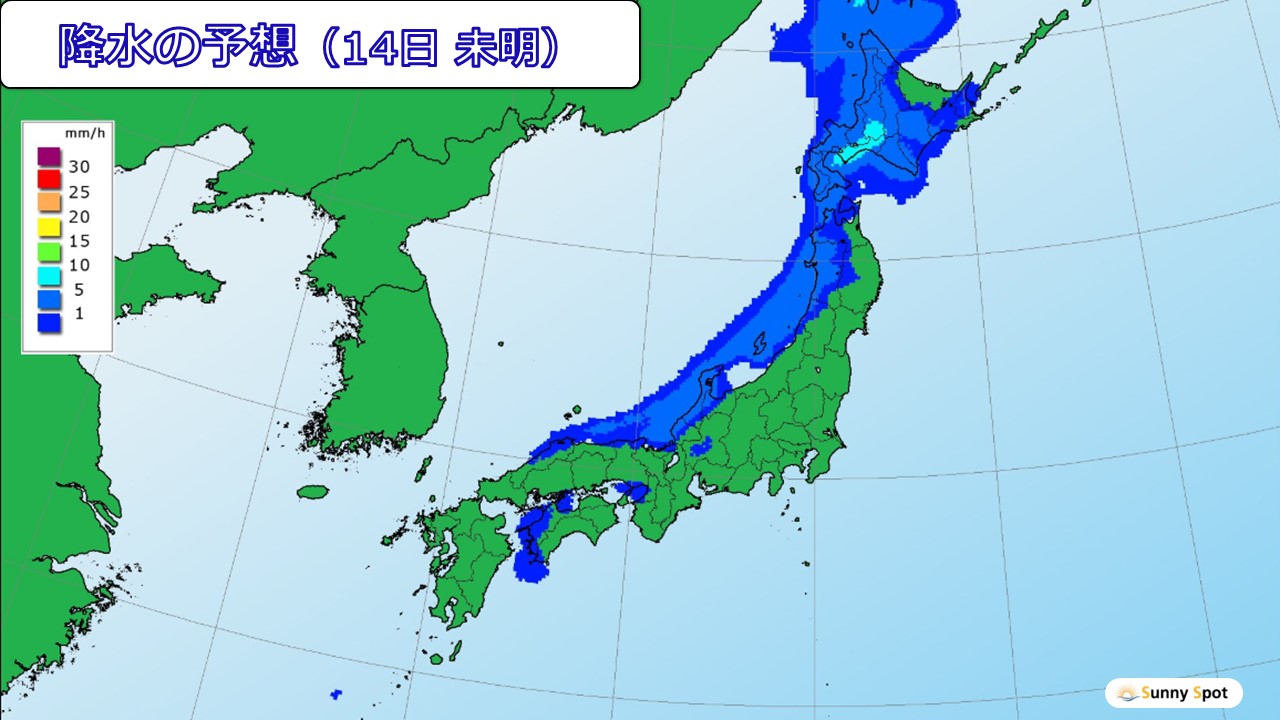
The front extending from this low-pressure system will pass over Honshu, bringing rain to a wide area on Wednesday the 14th.
Hokkaido faces a risk of heavy rain as the main body of the low-pressure system approaches; please stay updated with the latest information.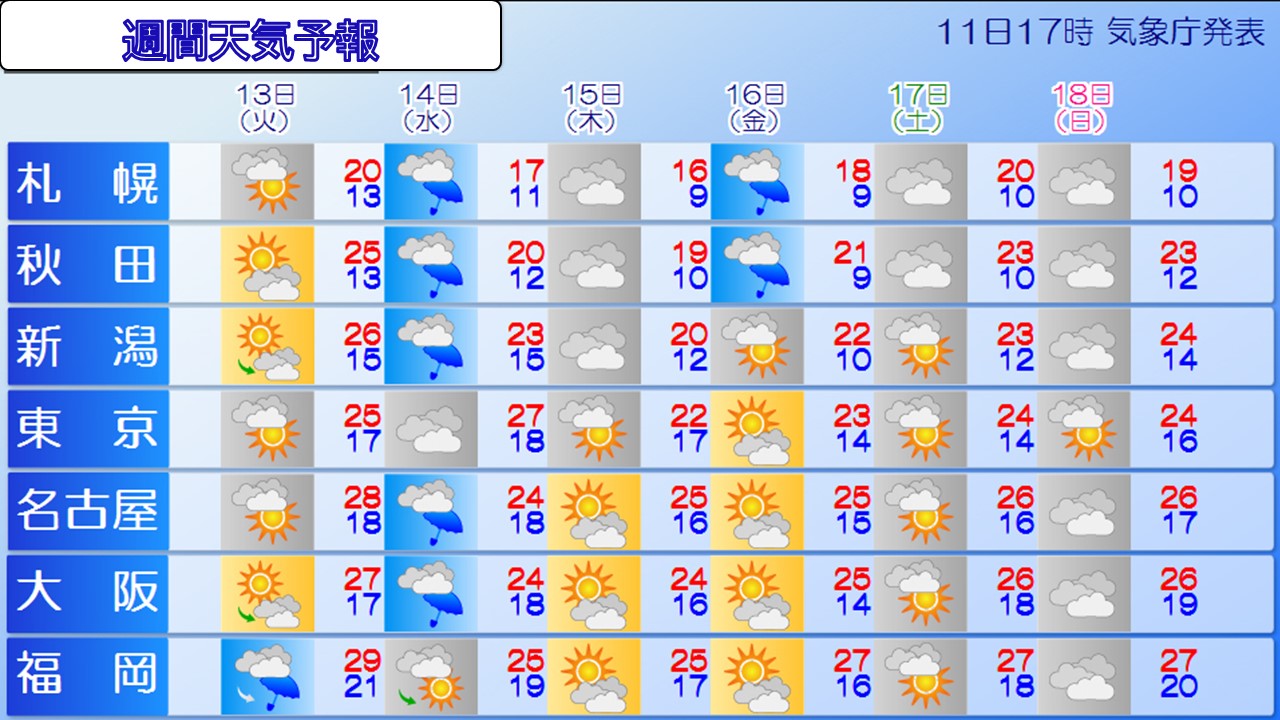
In Kyushu, the weather is expected to gradually improve from Wednesday onwards.
-
Weather for Today, Monday the 12th: A Great Day for Outings as Sunshine Prevails on the Last Day of the Long Weekend; Unsettled Conditions in Okinawa
2026/10/12 07:49
-
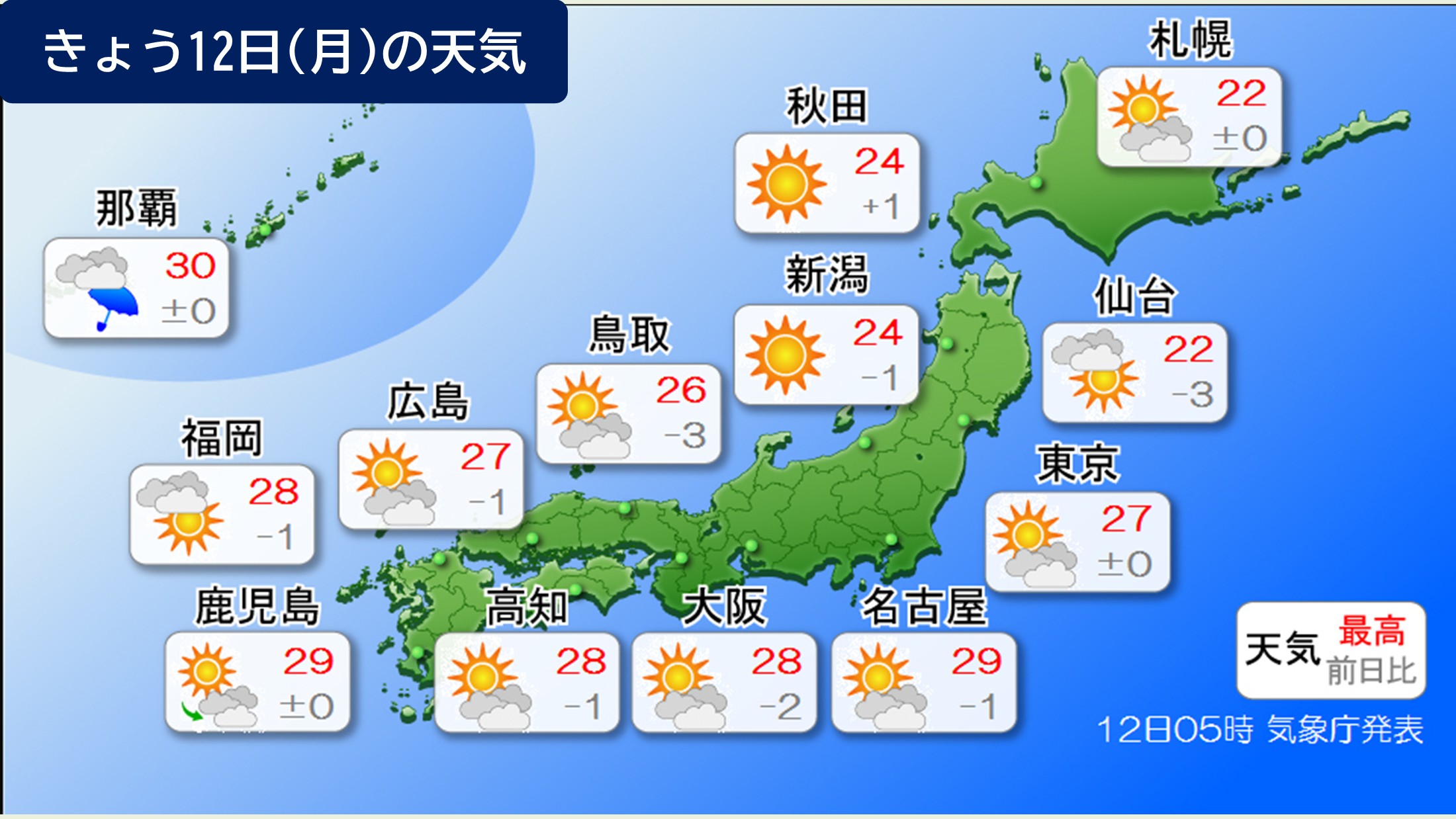
Today, Monday the 12th?the final day of the three-day weekend?the center of a migratory high-pressure system will move east of Hokkaido. However, as the system continues to cover the region, sunny weather is expected to persist across Northern and Eastern Japan.
In Western Japan, cloud cover will increase as the high-pressure system gradually moves away, but no significant deterioration in the weather is expected. There will be no widespread unsettled weather, and conditions will remain favorable for outings.
Meanwhile, clouds will spread over Okinawa, bringing a likelihood of rain.
Highs are forecast to be around 28, so it may feel somewhat hot when exposed to direct sunlight.
Northern and Eastern Japan, situated closer to the high-pressure system, will enjoy calm, sunny weather with little chance of rain.
Although the air may feel cool in the morning, the daytime will bring dry, pleasant conditions. Central Tokyo is expected to reach 27a "summer day" by Japanese standards?so please be mindful of the temperature difference throughout the day.
Today is "Sports Day"; if you engage in physical activity, please take precautions against heatstroke.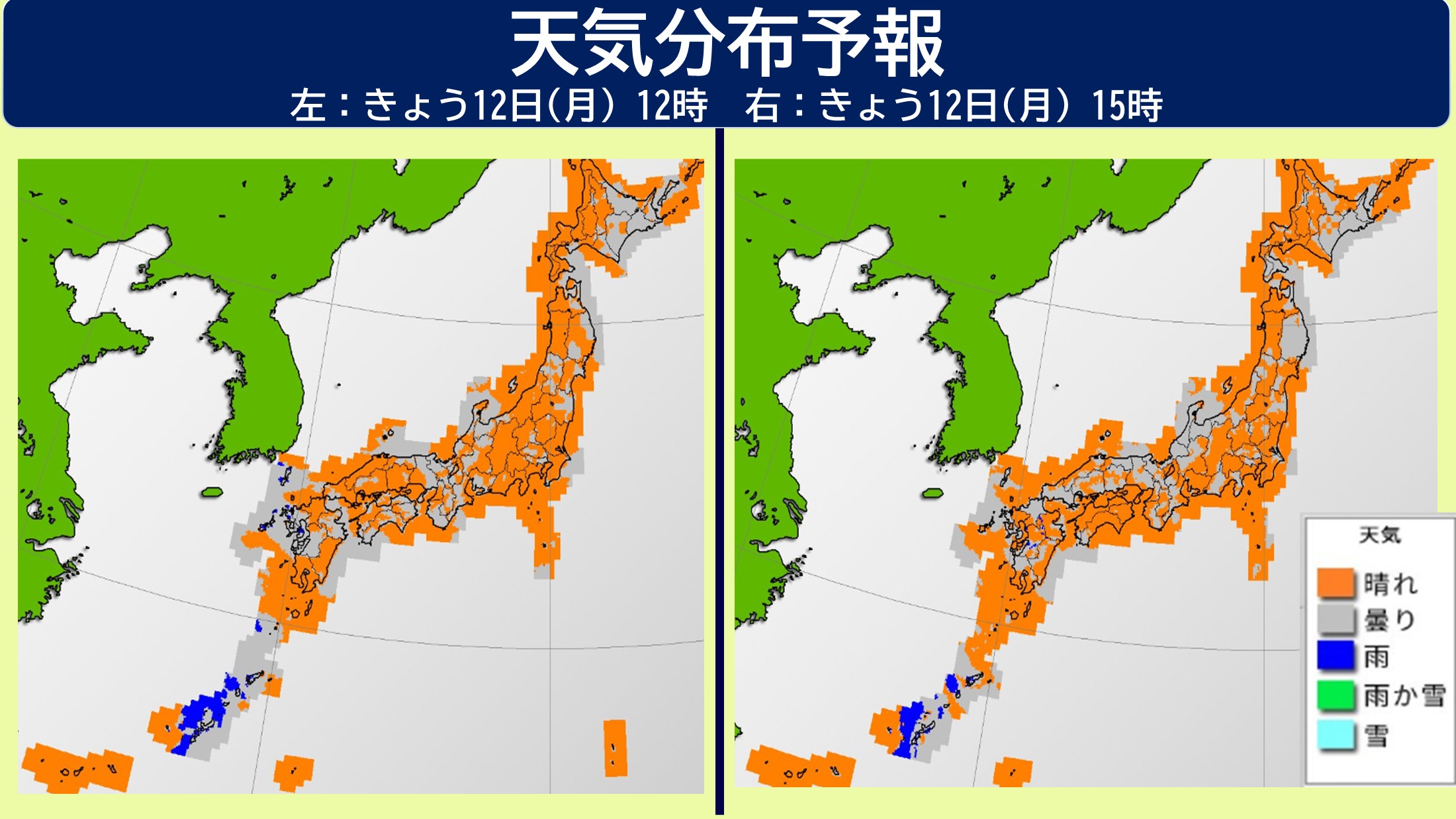
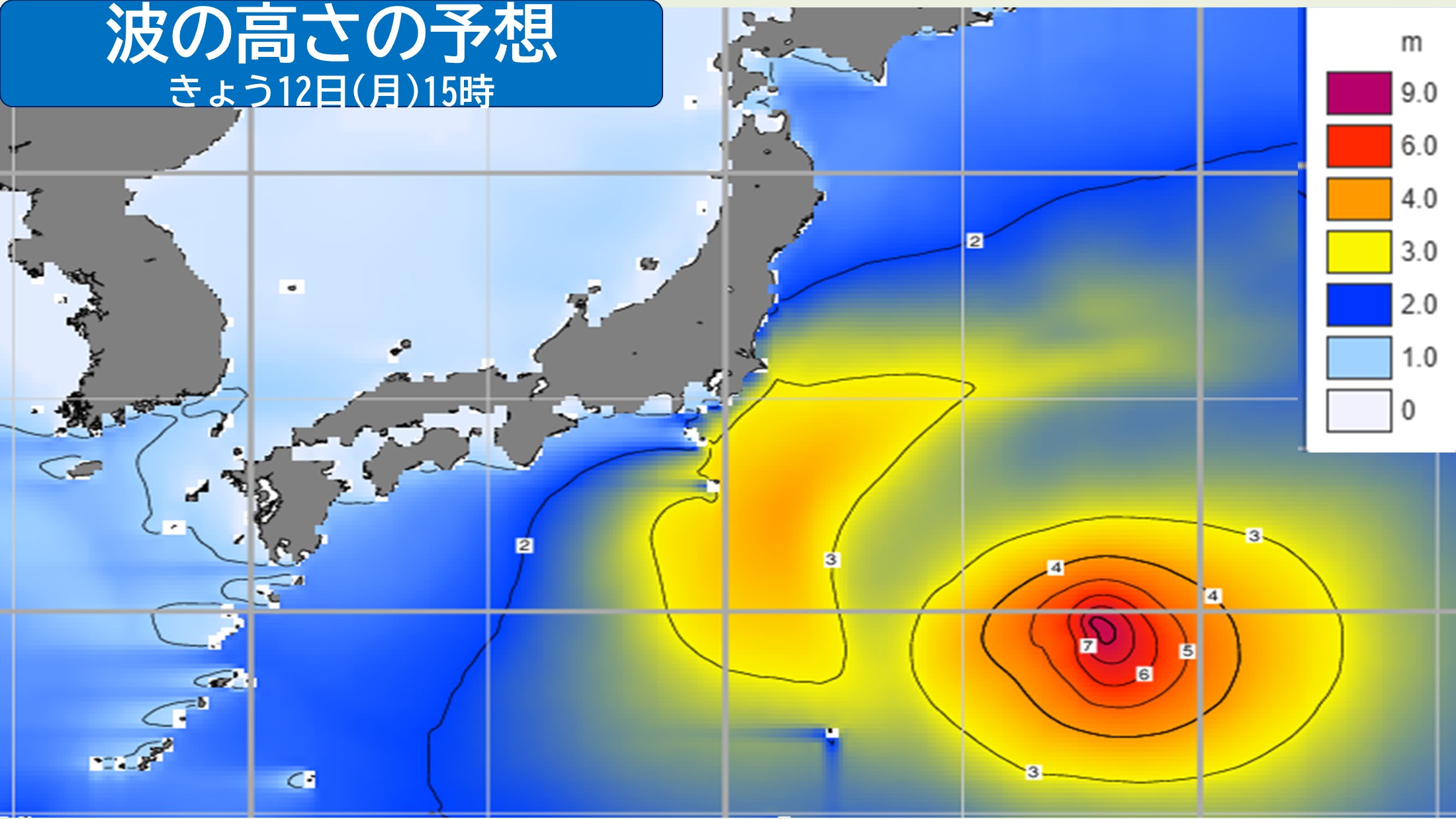
Please note that rough seas will persist along the Pacific coast from the Kanto region to the southern Tohoku region; if you are heading out for marine leisure activities, please be cautious of potential marine accidents.
-
Typhoon No. 29: Moving away to the east of Japan, but caution is advised regarding high waves and swells along the Pacific coast from the Kanto region to the southern Tohoku region.
2026/10/11 19:51
-
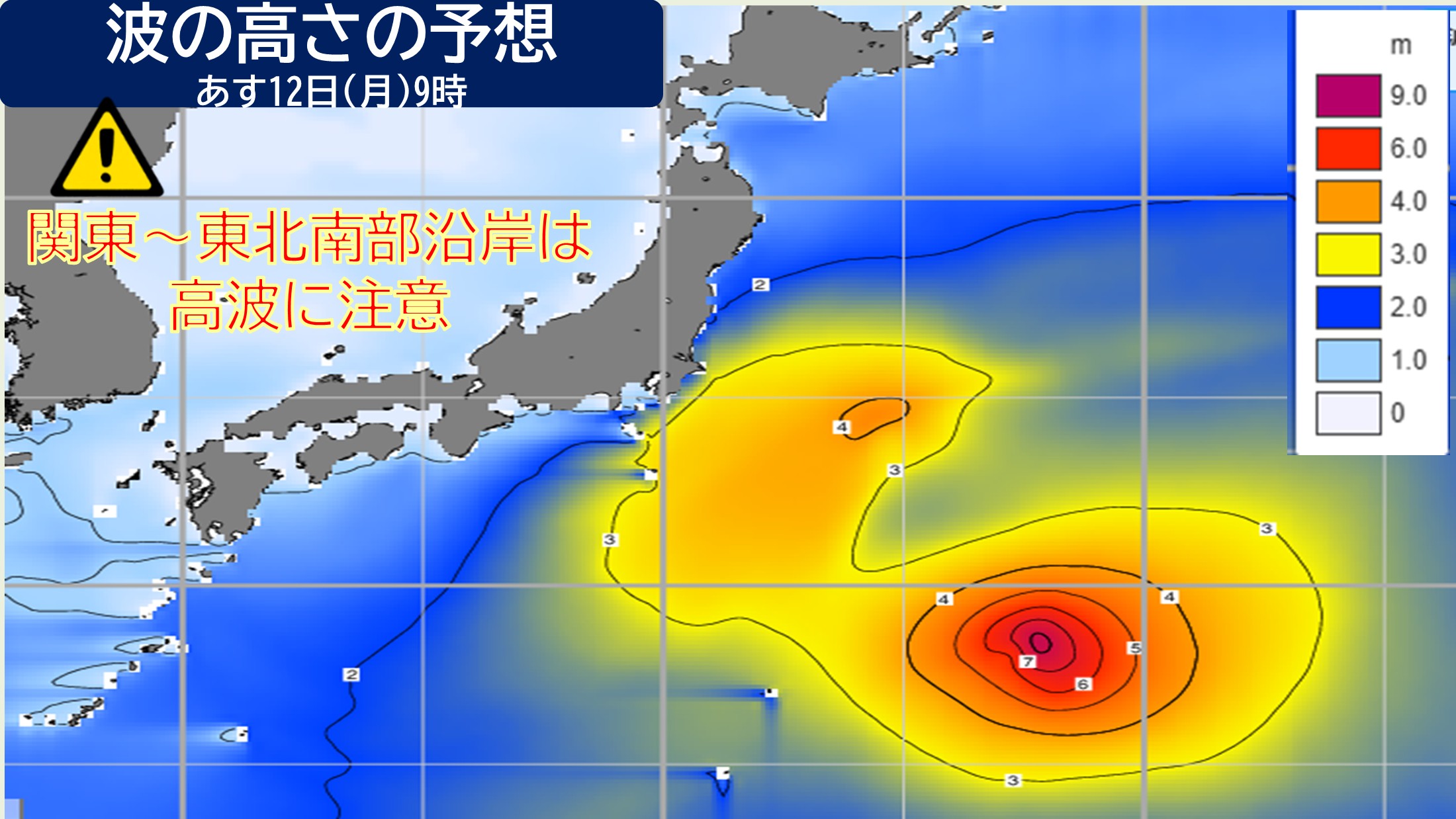
Typhoon No. 28 weakened into a tropical depression at 3:00 PM today, Sunday the 11th. Meanwhile, Typhoon No. 29 is moving northward in the waters near the Ogasawara Islands. Although both the tropical depression and the typhoon are tracking well away from Honshu, swells are expected to reach coastal areas along the Pacific, leading to higher waves in some places. Those planning marine leisure activities should exercise caution through tomorrow, Monday the 12th?the final day of the three-day weekend.
Typhoon No. 29 is currently located near the Ogasawara Islands, maintaining "very strong" intensity and moving north-northwest at 15 km/h. It is expected to continue moving northward over the waters east of Japan without approaching Honshu.
Typhoon No. 29 (Koguma) ? Saturday the 11th, 6:00 PM
Intensity: Very strong
Center Location: Near the Ogasawara Islands
Movement: North-northwest at 15 km/h
Central Pressure: 950 hPa
Max. Wind Speed: 45 m/s (near center)
Max. Gust Speed: 65 m/s
Although the tropical depression and the typhoon are moving far from Honshu, swells are reaching Pacific coastal areas stretching from Hokkaido to Okinawa, causing higher waves in some locations.
Tomorrow, Monday the 12th, Typhoon No. 29 is expected to move in a northerly direction near the Ogasawara Islands while maintaining its "very strong"intensity. It is expected to move east of Japan on the 13th (Tuesday) and transform into an extratropical cyclone far to the east of the country by the 14th (Wednesday).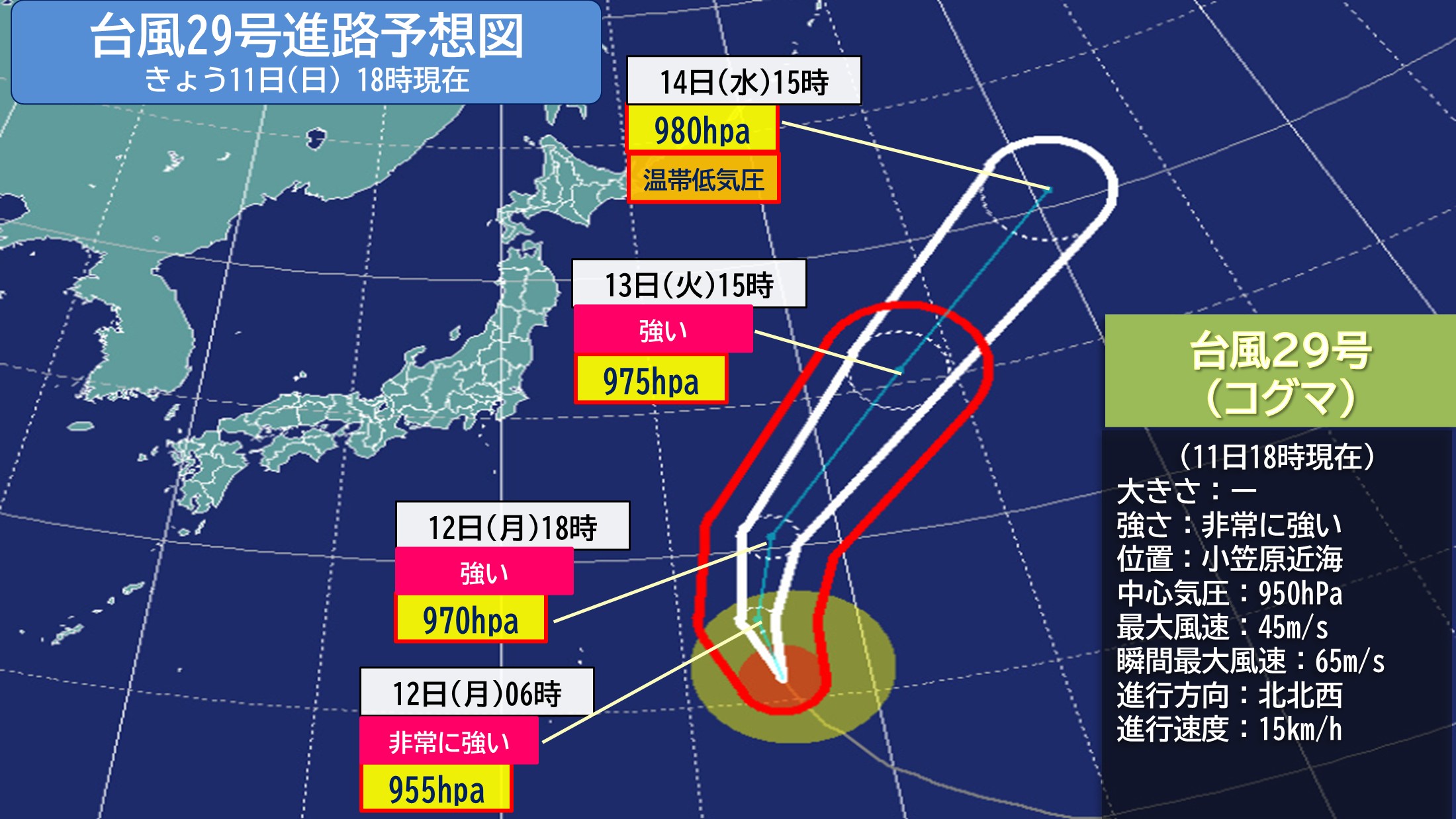
Even if the tropical depression?formerly Typhoon No. 28?weakens, Typhoon No. 29 is moving northward toward a similar area, so rough seas are likely to persist along the Pacific coast. Please remain cautious of high waves along the Pacific coast from the southern Tohoku region through the Kanto region through tomorrow, the 12th (Monday).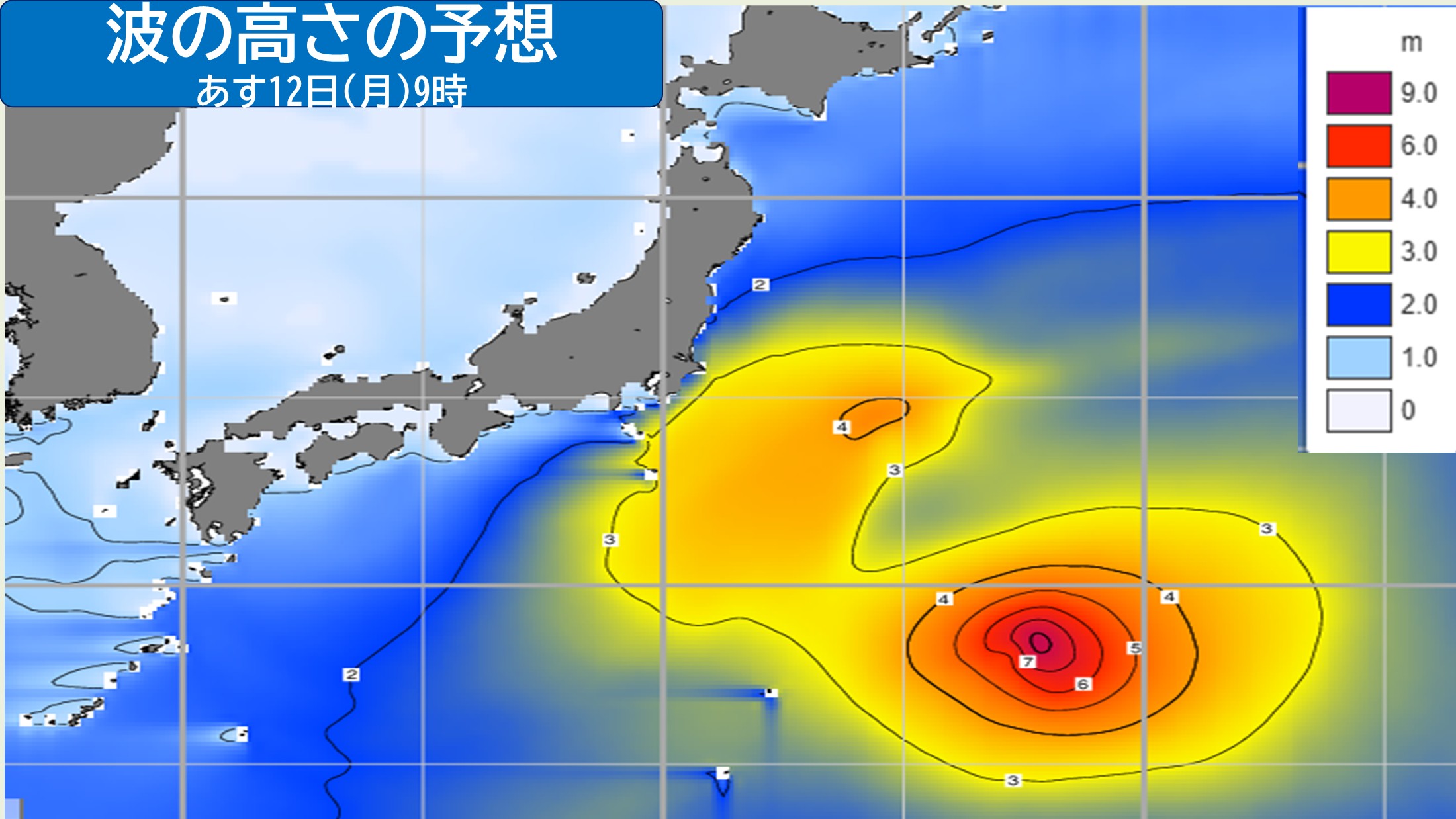
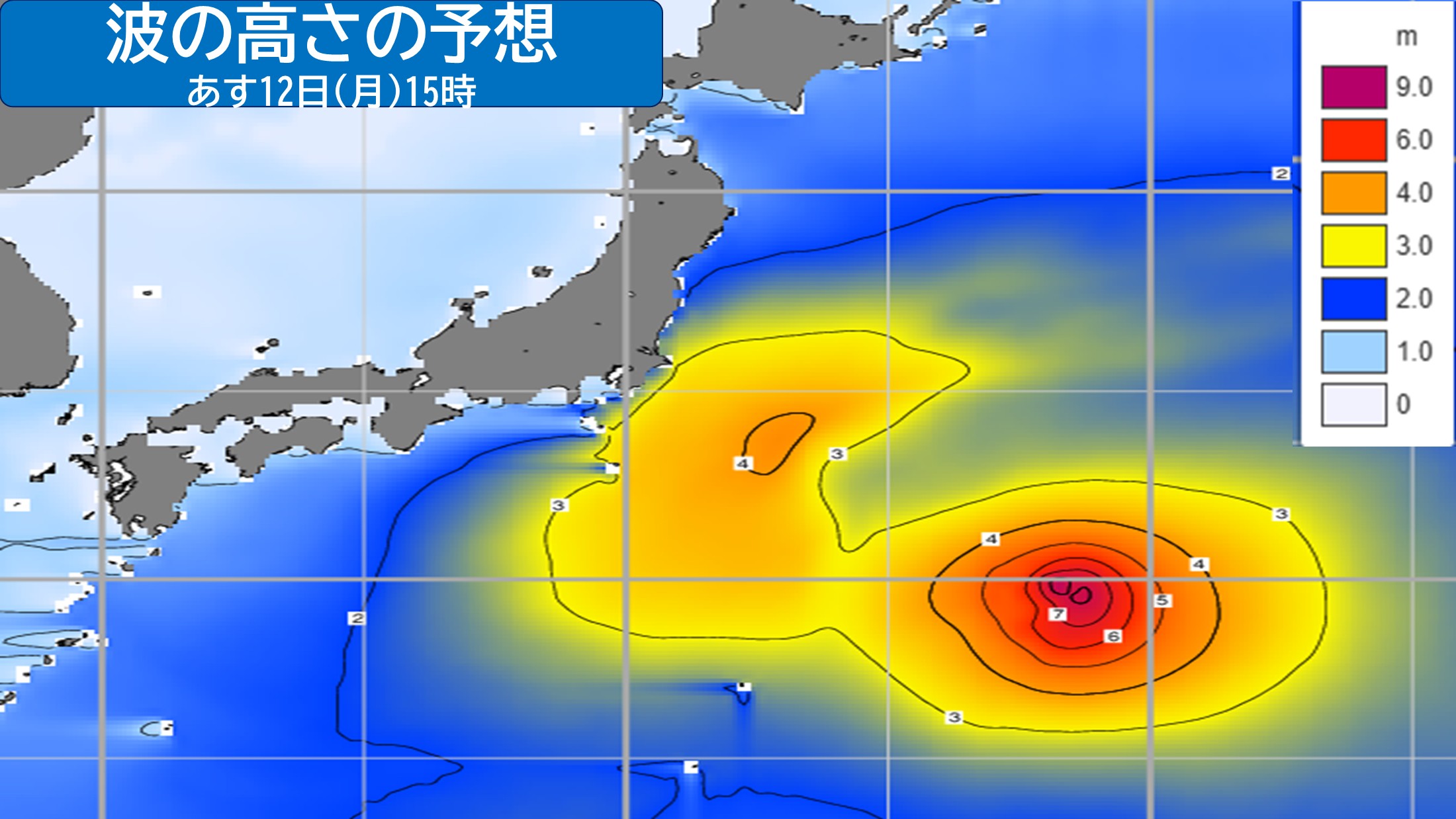
Furthermore, even if wave heights do not appear extreme, waves accompanied by swells can pack unexpectedly powerful force upon impact due to their long wavelengths. Please be alert for swells generated by the typhoons along other parts of the Pacific coast as well.
-
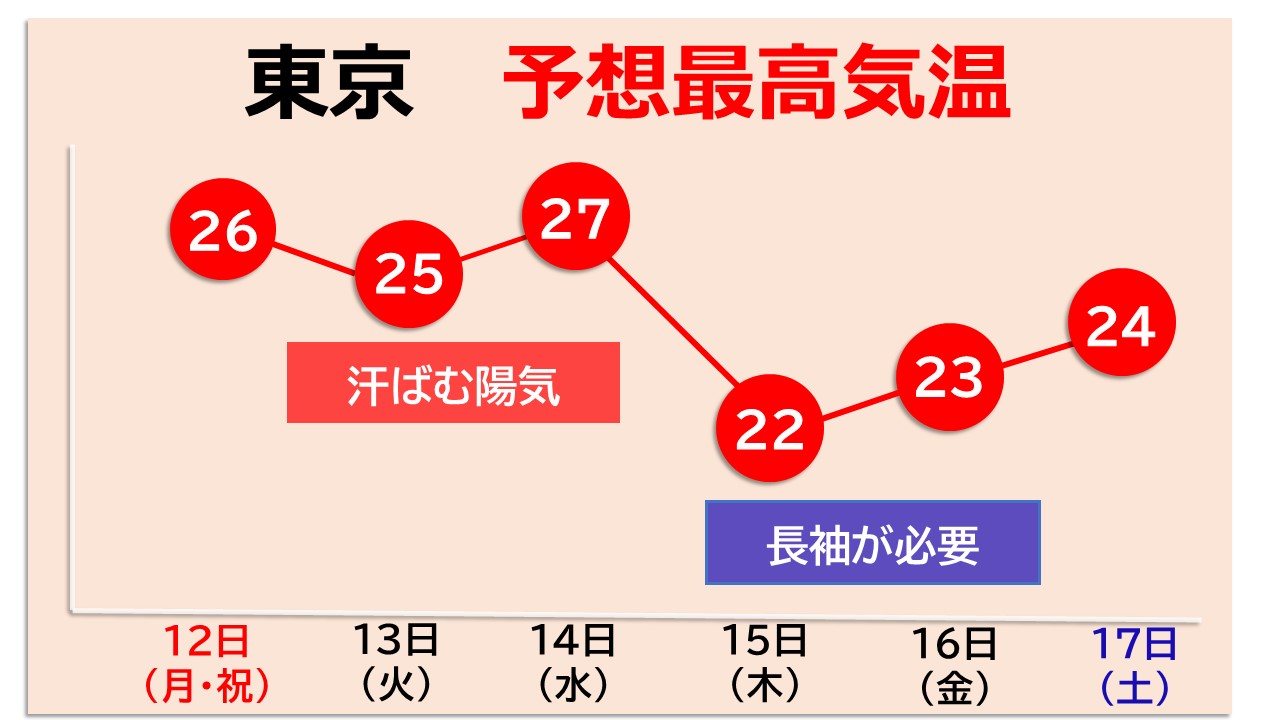
Honshu is enjoying clear autumn skies and balmy, sweat-inducing weather, but conditions will turn chilly in the latter half of next week.
2026/10/11 12:50
-
Today, Sunday the 11th, a high-pressure system is covering much of Honshu, bringing sunny skies to many areas.
Temperatures are rising in regions where the sun is shining, creating warm, muggy conditions across a wide area of ??Honshu.
Meanwhile, a low-pressure system over the East China Sea is moving slowly toward the northwest.
Atmospheric conditions have become unstable over the Nansei Islands, where rain accompanied by thunder is currently being observed.
The low-pressure system over the East China Sea is expected to gradually dissipate starting tomorrow, Monday the 12th (a public holiday).
However, a new low-pressure system is expected to form over the Sea of ??Japan on Tuesday the 13th and move northward, accompanied by a front.
As cold air moves in aloft following the passage of this low-pressure system,
temperatures during the latter half of next week will likely drop to levels requiring long-sleeved clothing.
The season is expected to advance another step forward.
Please take care to avoid falling ill due to these sudden changes in temperature.
-
[El Niño Monitoring Update] Equatorial Pacific Sea Surface Temperatures Reach Record Highs
2026/10/11 12:10
-
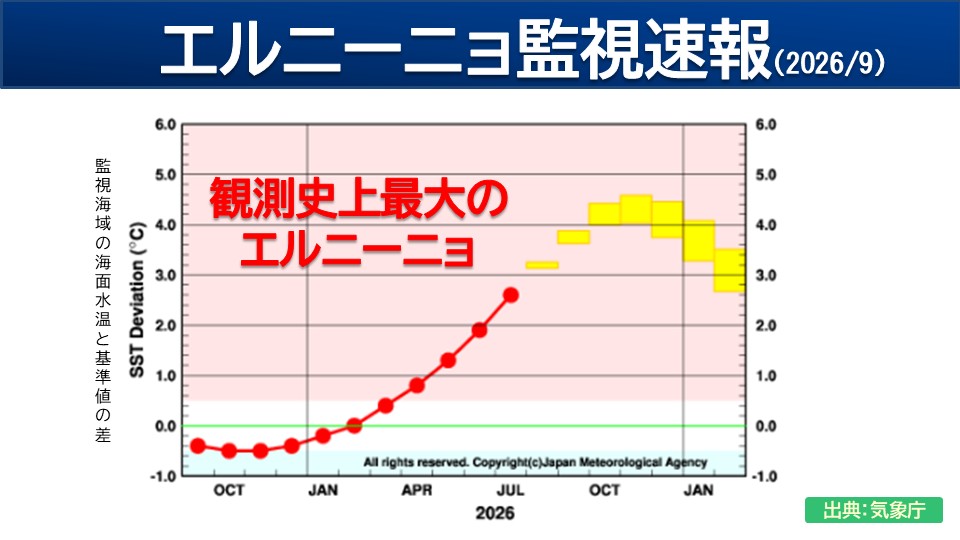
On Friday the 9th, the Japan Meteorological Agency (JMA) released its latest El Ni?o monitoring report.
According to the report, the sea surface temperature in the El Ni?o monitoring region rose to 4.0C above the baseline value in September. This figure surpasses the peak value of 3.6C recorded in December 1997?previously the highest on record?making this the strongest event to date.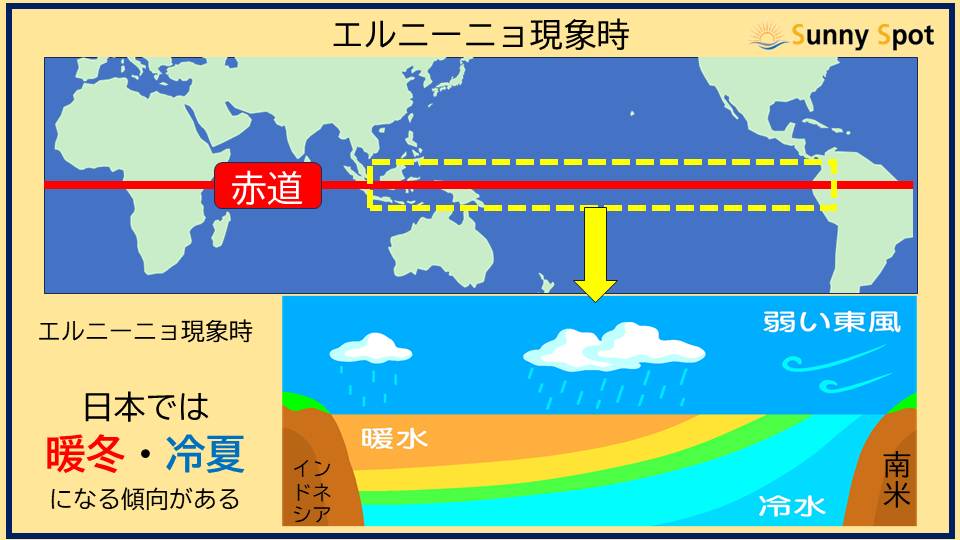
The El Ni?o phenomenon is characterized by sea surface temperatures in the equatorial Pacific?stretching from near the International Date Line to the coast of South America?rising above normal levels and remaining in that state for approximately one year. As the area of ??elevated sea surface temperatures expands beyond its usual range, it influences climates across the globe.
Statistically, the occurrence of an El Ni?o event tends to bring cooler summers and warmer winters to the region around Japan.
The JMA defines an "El Ni?o phenomenon" as an event where the five-month running average of the difference between the sea surface temperature in the monitoring region and the baseline value remains at +0.5C or higher for six consecutive months or more.
Additionally, a situation where the three-month average difference from the normal sea surface temperature reaches +2C or higher is sometimes colloquially referred to as a "Super El Ni?o." This is an extremely rare occurrence; previously confirmed instances took place in 1982?83, 1997?98, and 2015?16.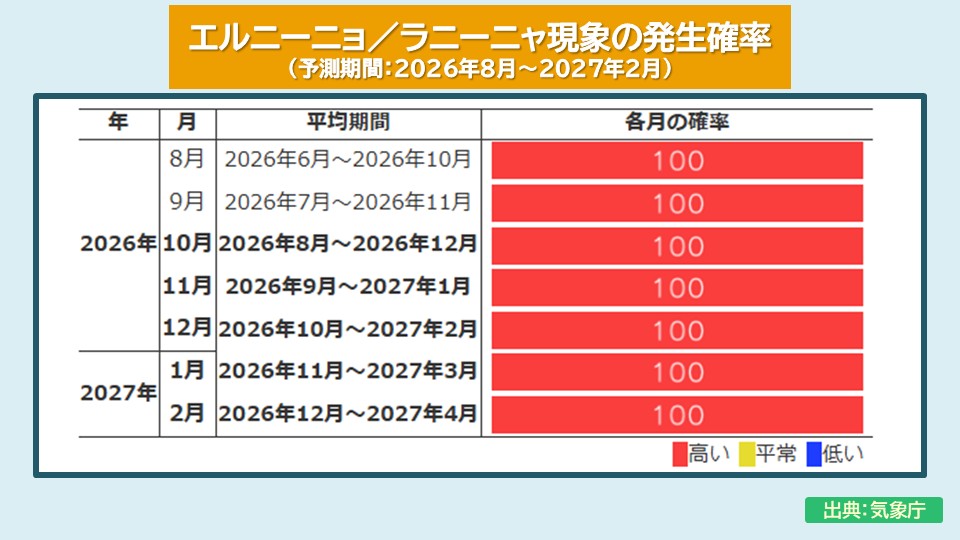
The Japan Meteorological Agency (JMA) forecasts that the El Ni?o phenomenon will persist through the winter, with a 100% probability predicted in the monthly El Ni?o monitoring indices.
According to the JMA's atmosphere-ocean coupled model, interactions between the atmosphere and the ocean are expected to maintain a layer of warm surface water across the central to eastern equatorial Pacific. Consequently, sea surface temperatures in the El Ni?o monitoring region are projected to remain above normal levels through the winter, eventually reaching their peak.
-
Weekly Weather: High pressure dominates, bringing many sunny days; weather to deteriorate after the long weekend.
2026/10/11 07:25
-
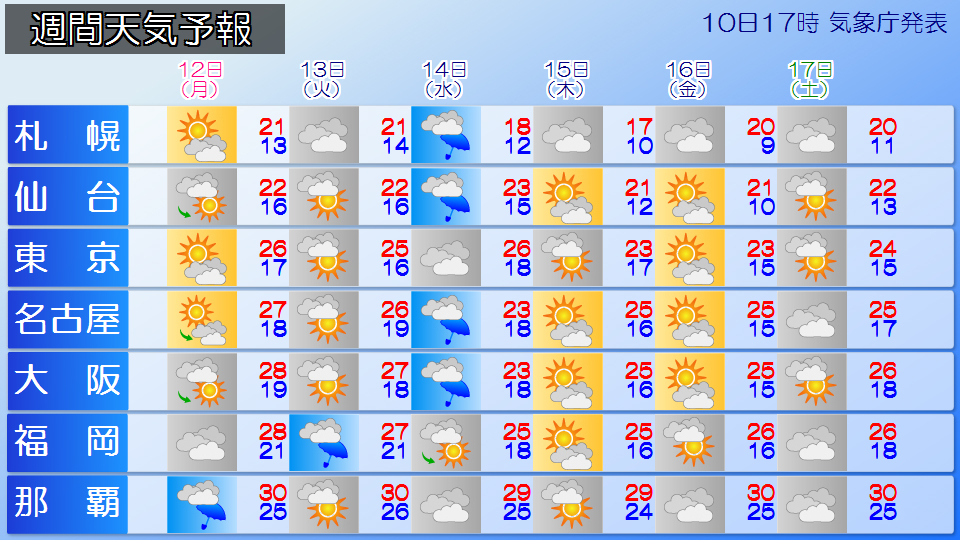
In the coming days, the area around Honshu will largely be under the influence of high-pressure systems. However, after the long weekend, the weather is expected to deteriorate temporarily, particularly along the Sea of ??Japan coast.
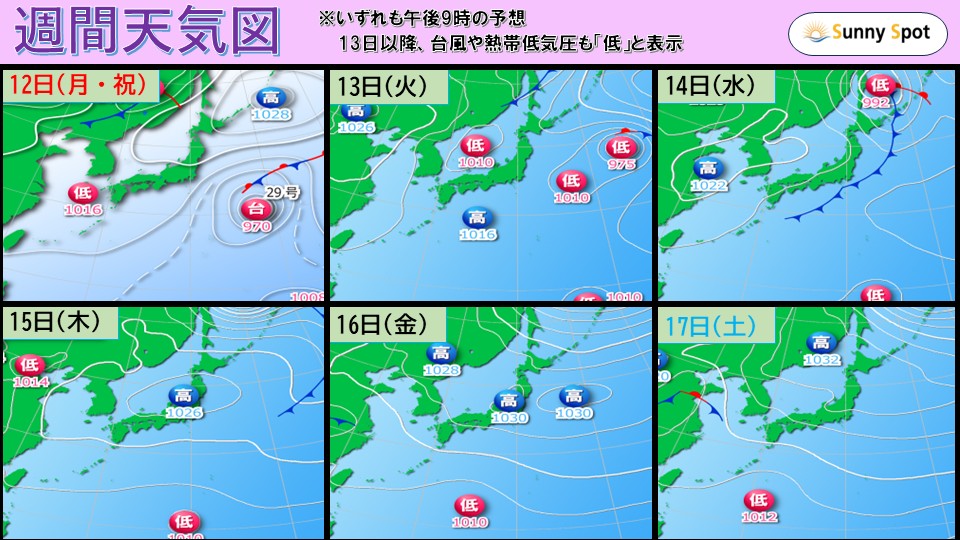
Tomorrow, the 12th (Monday)?the final day of the long weekend?will see sunny skies across many areas as high pressure dominates. However, a low-pressure system over the East China Sea will bring increasing cloud cover to Kyushu and Okinawa, with localized rain likely.
On the 13th (Tuesday), following the long weekend, the weather will take a turn for the worse in western Japan due to an approaching low-pressure system moving in from the west. Rain will gradually spread, primarily along the Sea of ??Japan coast?affecting areas such as northern Kyushu and the San'in region?and is expected to extend from the Kinki region up to Hokkaido by the 14th (Tuesday). As the front passes, rainfall may intensify temporarily in some areas.
However, the period of rain will be brief; afterwards, the region is expected to come under the influence of high pressure again, bringing sunny skies to many areas.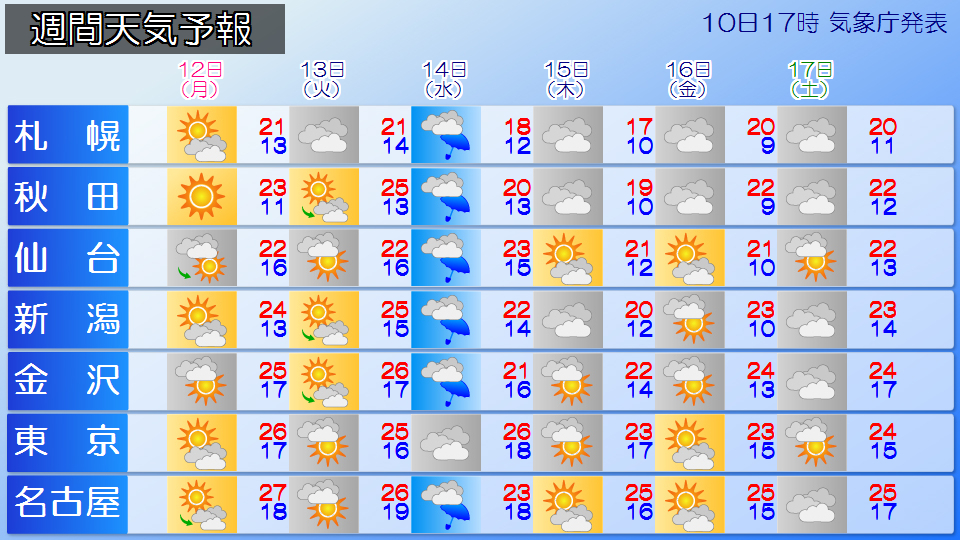
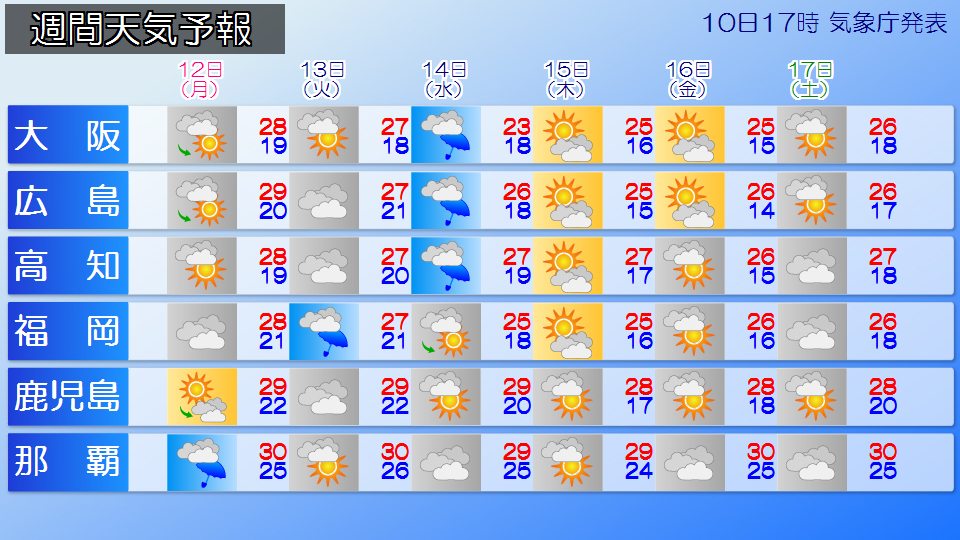
Temperatures across the country are expected to trend higher than average for this time of year. However, there will likely be a significant difference between daytime highs and morning/evening lows. Please take care to manage your health amidst these temperature fluctuations.
In Hokkaido and northern Tohoku, morning lows may drop below 10C in some areas. The autumn foliage will likely begin to turn color in high-altitude mountainous areas.
-
Weather forecast for today, the 11th (Sunday): Sunny across a wide area—perfect for outings; rain likely in southern Kyushu and Okinawa.
2026/10/11 06:35
-
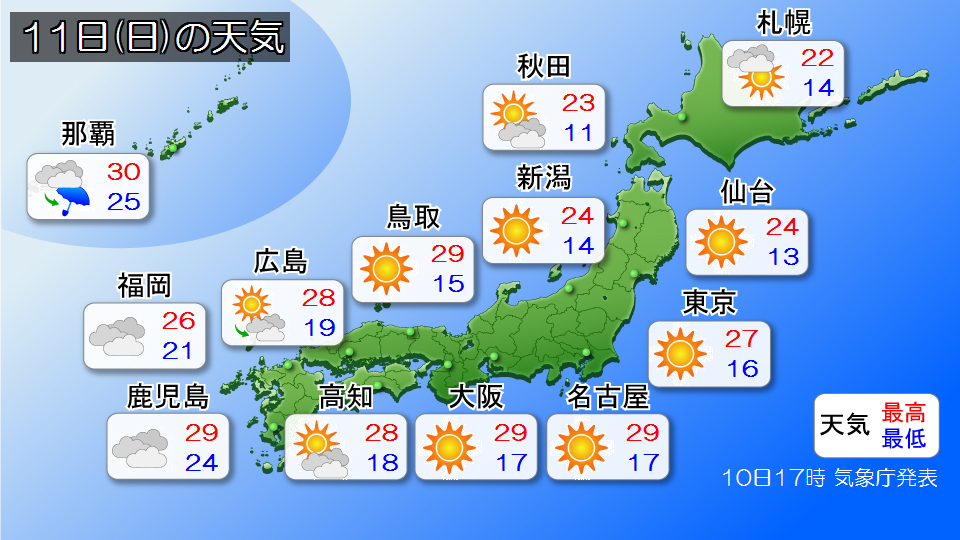
Today, Sunday the 11th?the second day of the long weekend?high pressure will cover a wide area around Honshu. Meanwhile, a trough of low pressure exists over the East China Sea, and developed rain clouds associated with a low-pressure system can be seen over the waters west of Kyushu and near Okinawa.
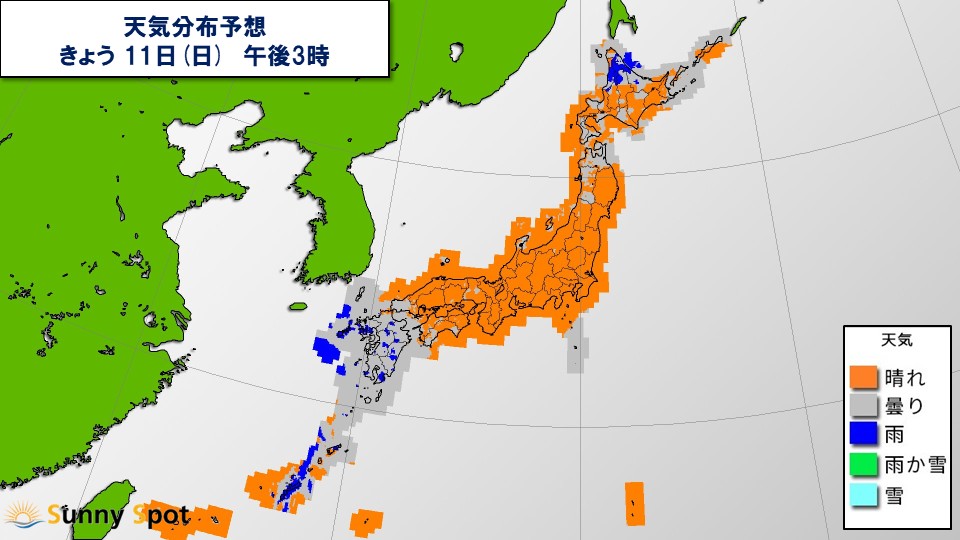
Skies will be clear across much of the Honshu region today, with few areas expecting significant weather deterioration; it promises to be an ideal day for leisure activities. Daytime temperatures will hover around 25C in many places, while Nagoya, Kyoto, and Osaka may see highs reaching approximately 30C.
In northern Hokkaido, scattered showers are likely at times between midday and evening. Although the area affected by rain will be limited, it would be wise to carry a folding umbrella.
Rain is likely in southern Kyushu and Okinawa due to the influence of the low-pressure system. In Kyushu, even locations where the forecast does not explicitly show a rain symbol may experience sudden showers or thunderstorms. On the main island of Okinawa, please be alert for heavy rain accompanied by thunder.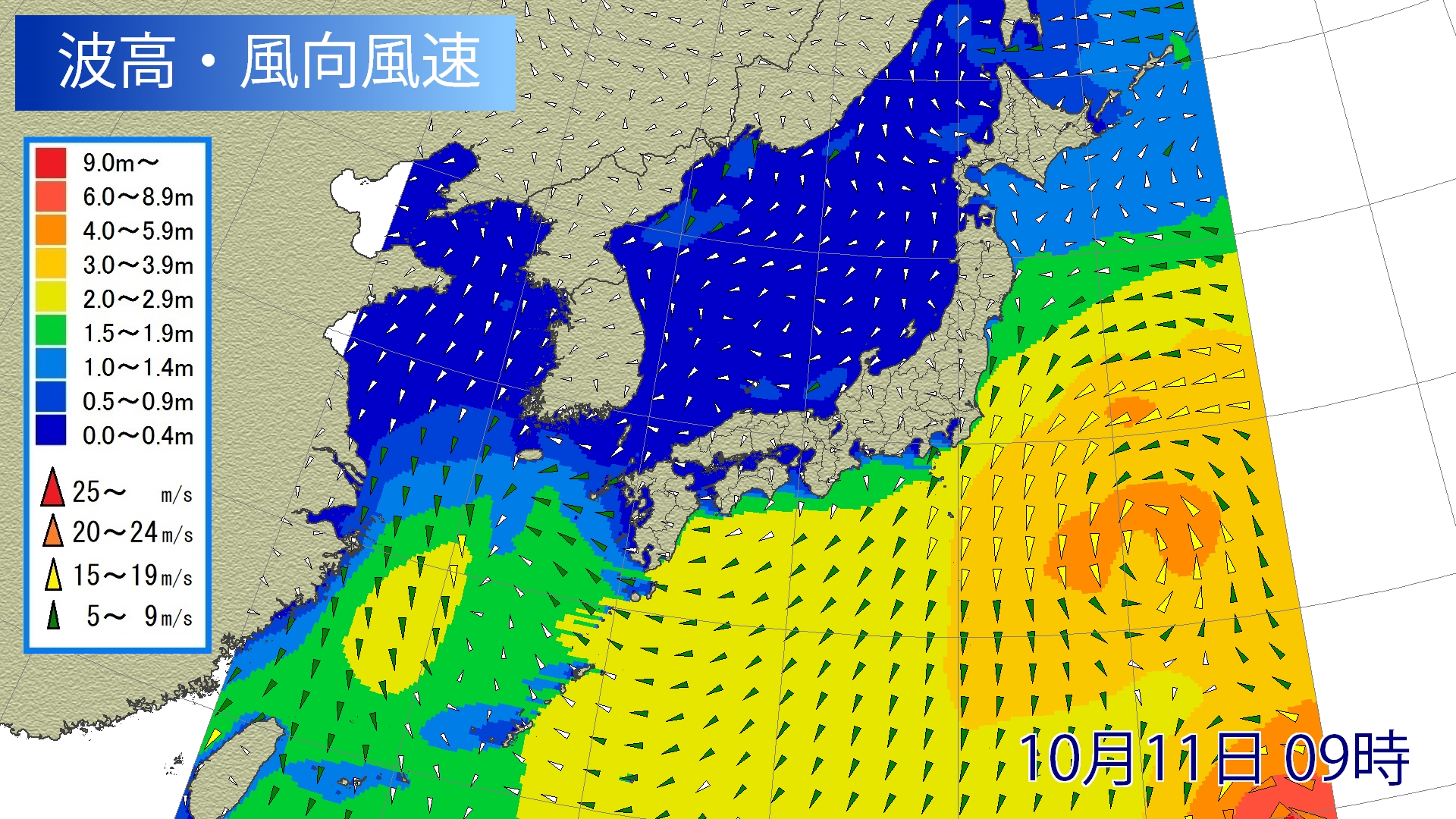
Typhoon No. 28 is moving northward over the waters east of Japan, while the very strong Typhoon No. 29 is moving northwest near Minami-Torishima. Although there is little chance of either typhoon approaching Honshu directly, swells generated by the typhoons will reach the Pacific coast?including the Kanto region?causing rough seas to persist. Please exercise caution regarding high waves accompanied by these swells.
-
[Twin Typhoons] Typhoons 28 and 29 moving north off the east coast of Japan; coastal areas warned of high waves.
2026/10/10 16:53
-
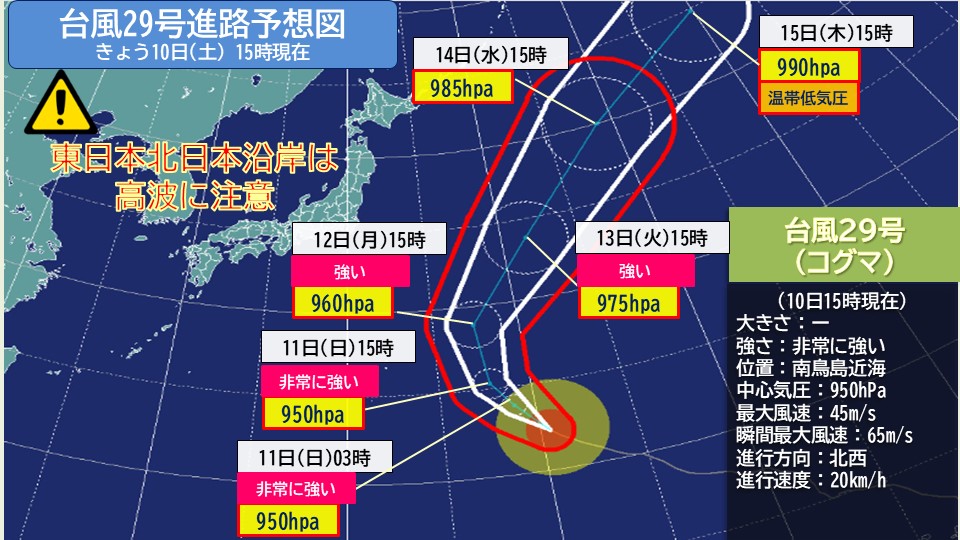
Typhoons No. 28 and No. 29 are expected to move northward over the waters east of Japan. While they are forecast to stay away from the Japanese mainland, coastal areas will likely experience high waves. Those planning marine leisure activities during this three-day weekend should be cautious of high waves accompanied by swells.
As of 3:00 PM today, Saturday the 10th, Typhoon No. 28 (Noru) is moving north-northwest over the waters east of Japan. It has a central pressure of 994 hPa and maximum sustained winds of 23 m/s near its center.
Typhoon No. 28 (Noru) Saturday the 10th, 3:00 PM
Center location: Near Minamitorishima
Movement: North-northwest at 10 km/h
Central pressure: 994 hPa
Max. sustained wind: 23 m/s (near center)
Max. instantaneous wind: 35 m/s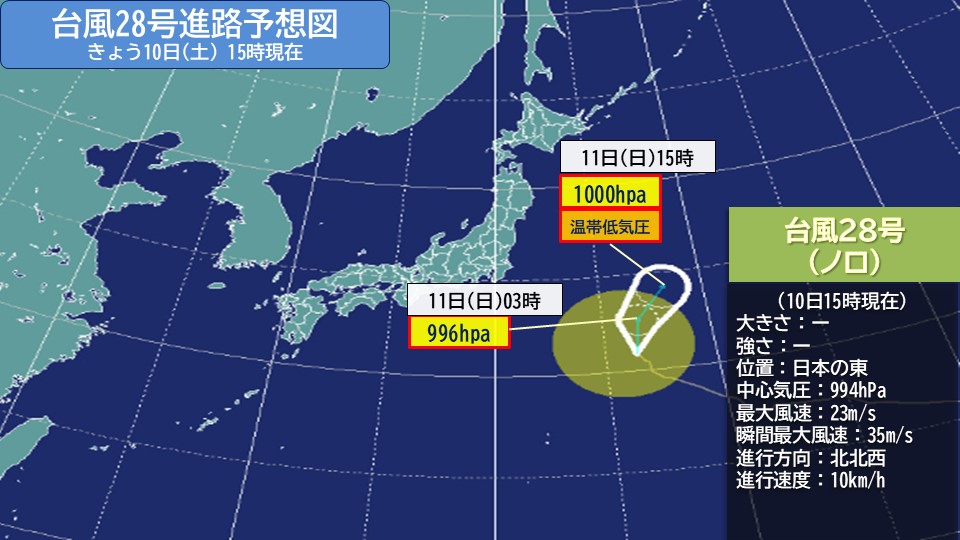
The storm is expected to transform into an extratropical cyclone by 3:00 PM tomorrow, the 11th, and move northward over the waters east of Japan. Even after transitioning into an extratropical cyclone, it is forecast to continue moving northward without approaching the Japanese archipelago.
Meanwhile, as of 3:00 PM today, Saturday the 10th, Typhoon No. 29 (Koguma) is moving west-northwest near Minamitorishima with very strong intensity. The central pressure is 955 hPa, and the maximum wind speed near the center is 45 m/s.
Typhoon No. 29 (Koguma) Saturday the 10th, 3:00 PM
Intensity:Very strong
Center location: Waters near Minamitorishima
Movement: Northwest at 20 km/h
Central pressure:950 hPa
Max wind speed: 45 m/s (near center)
Max gust speed: 65 m/s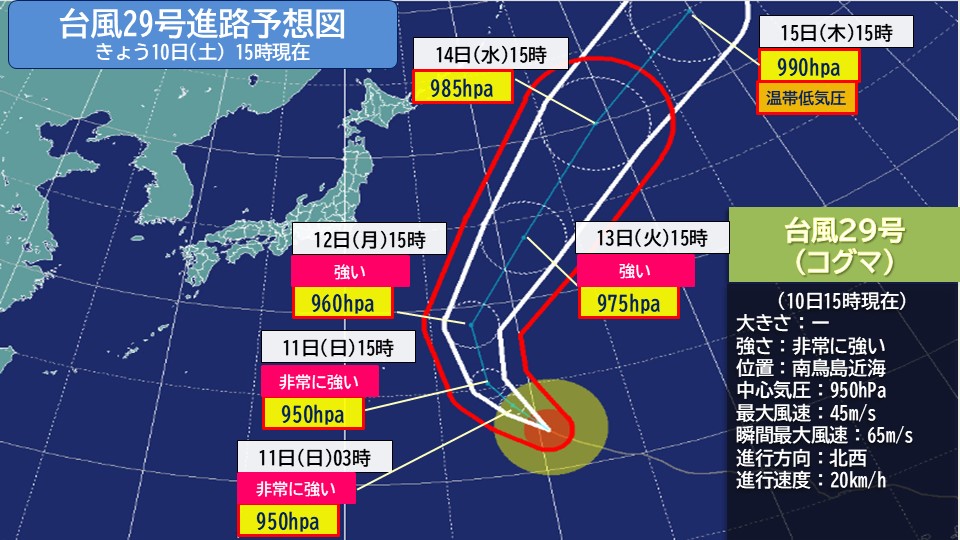
It is expected to continue moving northward while maintaining its "very strong" intensity. Like the other storm, it will not approach the Japanese archipelago and is forecast to transform into an extratropical cyclone east of the Kuril Islands on Thursday the 15th.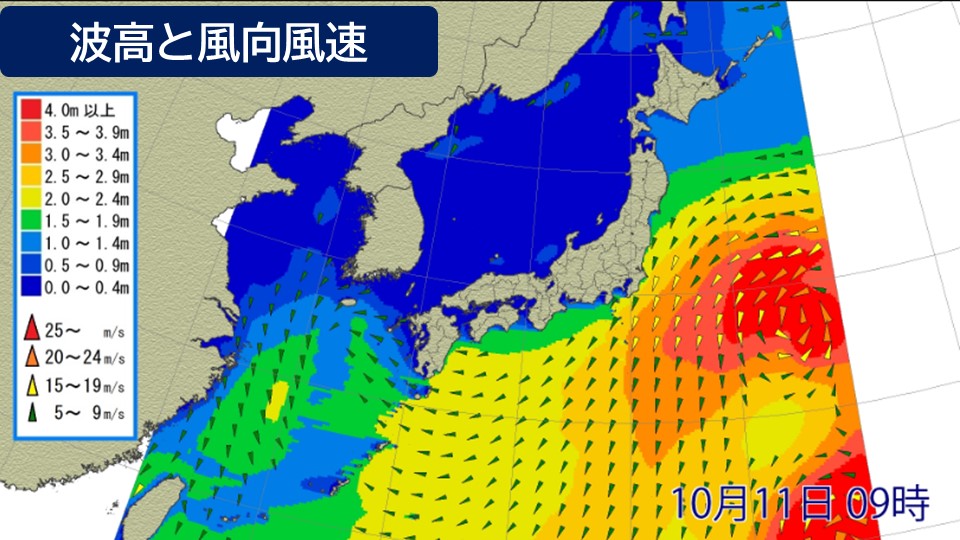
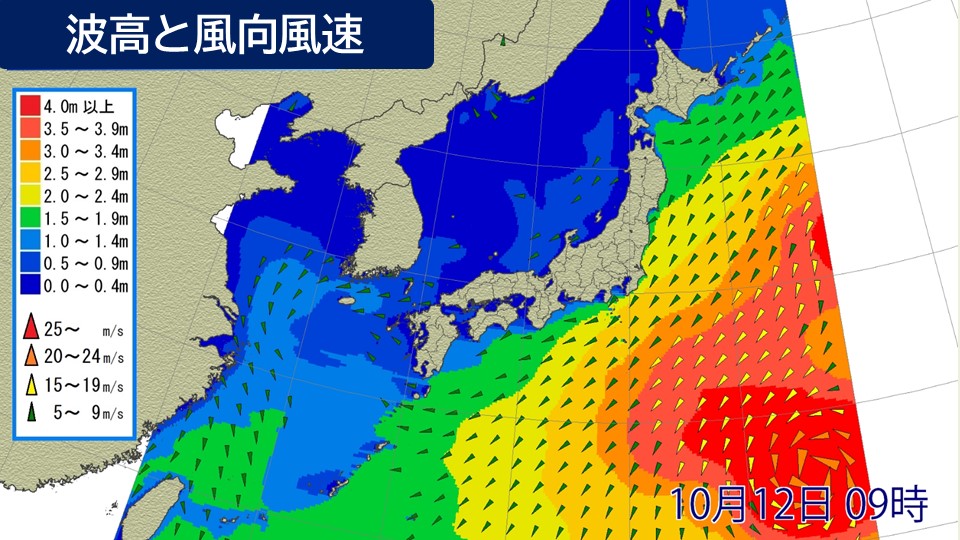
Although both Typhoon No. 28 and Typhoon No. 29 will travel well away from the Japanese archipelago, one should not let their guard down. Swells generated by the typhoon will reach the Pacific coast, likely causing high waves in some areas. Furthermore, as Typhoon No. 29 is forecast to follow a path similar to that of Typhoon No. 28, rough sea conditions are expected to persist, particularly in the waters east of Japan.
Caution is advised regarding high waves accompanied by swells, especially along the coasts of the Kanto, Tokai, and Tohoku regions. If you are planning marine leisure activities during this three-day weekend, please exercise due caution and enjoy yourselves safely.
-
[A Turnaround from Sunlight Shortage] Tokyo's October Sunshine: Just 9 Days In, It Already Surpasses September's Total
2026/10/10 13:12
-
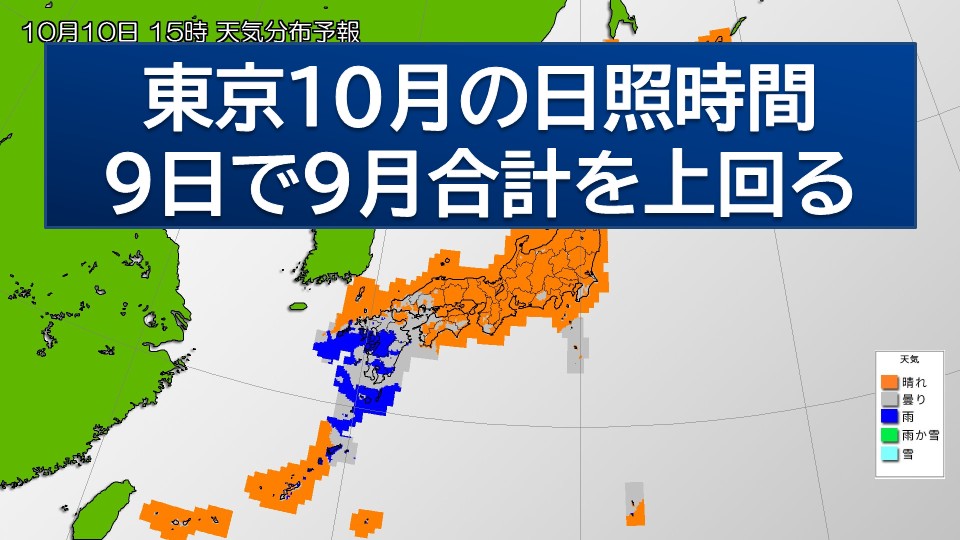
Cumulative sunshine duration in central Tokyo reached 46.4 hours by October 9, surpassing the total recorded for the entire month of September (45.8 hours).
In September, Tokyo experienced a succession of rainy days due to the autumn rain front and typhoons, resulting in sunshine duration that was only about one-third of the seasonal average.
In contrast, October has seen the region covered by a migratory high-pressure system, bringing a stretch of clear autumn weather; by October 9, the accumulated sunshine had already exceeded the total for the previous month.
A Stretch of Clear Autumn Weather Since the Start of October
On Thursday, October 1, Typhoon No. 26 and the autumn rain front moved away to the east, and central Tokyo saw sunshine exceed three hours before noon. Subsequently, the area came under the influence of a migratory high-pressure system, leading to a series of days with typical clear autumn weather. Notably, on October 8 and 9, daily sunshine exceeded 10 hours?the first time this had happened since August 25?pushing the cumulative total to 46.4 hours.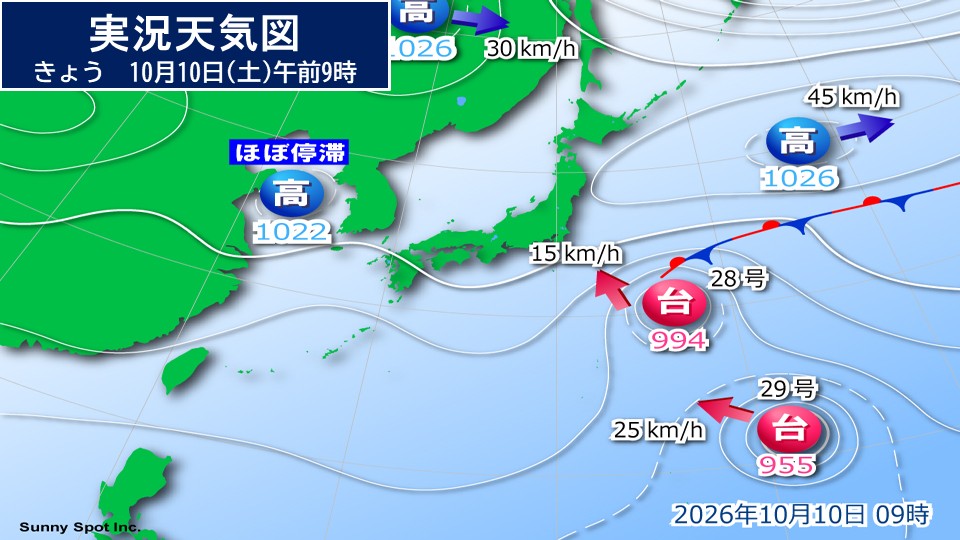
However, this does not necessarily indicate that this October has an unusually high number of clear days. When comparing the total sunshine duration for the first ten days of the month against the seasonal average, the figure stands at 122%, indicating levels roughly comparable to a typical year.
Clear Autumn Weather to Continue
According to the Japan Meteorological Agency's one-month forecast, the region is likely to remain under the influence of high-pressure systems throughout October, with the Kanto region expected to see more sunny days than usual. Although Typhoons No. 28 and 29 have currently formed, both are expected to travel northward along the edge of the high-pressure system to the east of Japan, meaning the clear autumn weather across Honshu is likely to persist.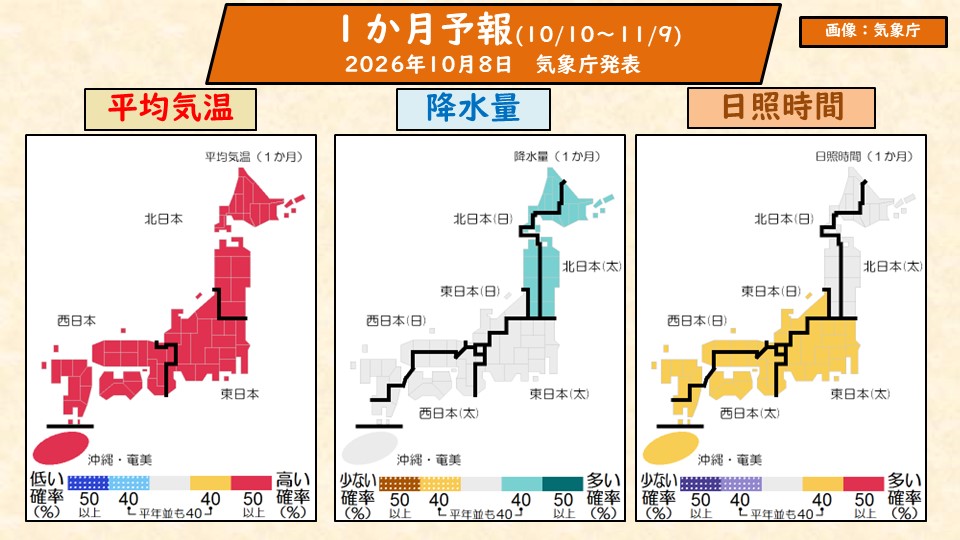
-
Today's weather forecast (Saturday, the 10th): The first day of the three-day weekend will be mostly sunny autumn weather, but be aware of thunderstorms in Kyushu and Okinawa.
2026/10/10 06:56
-
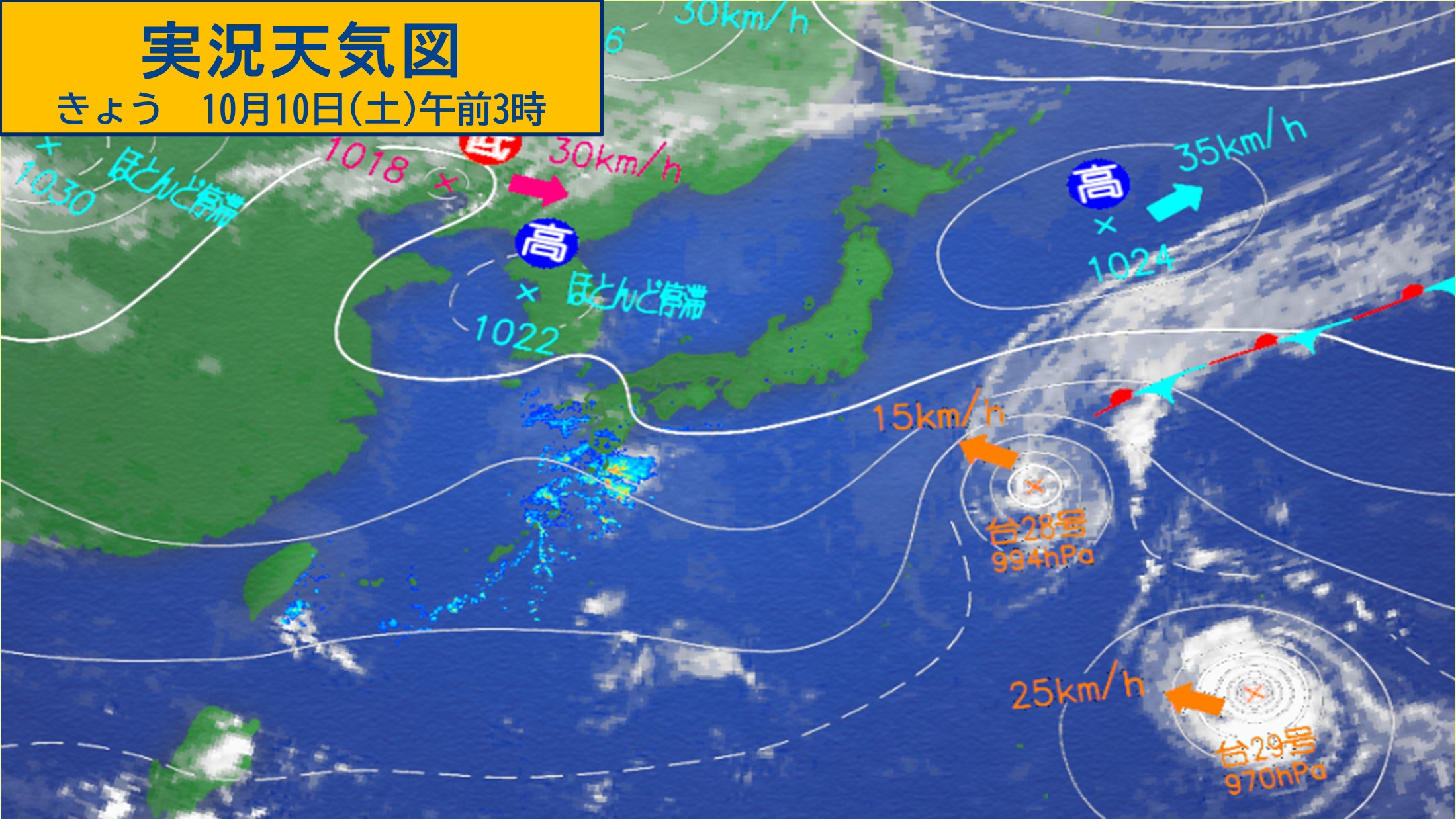
Today, Saturday the 10th-the first day of the three-day weekend-most of Honshu will be under the gentle influence of a high-pressure system, bringing widespread, clear autumn weather. In contrast, clouds are likely to spread across northern Hokkaido, while Kyushu and Okinawa can expect conditions prone to rain.
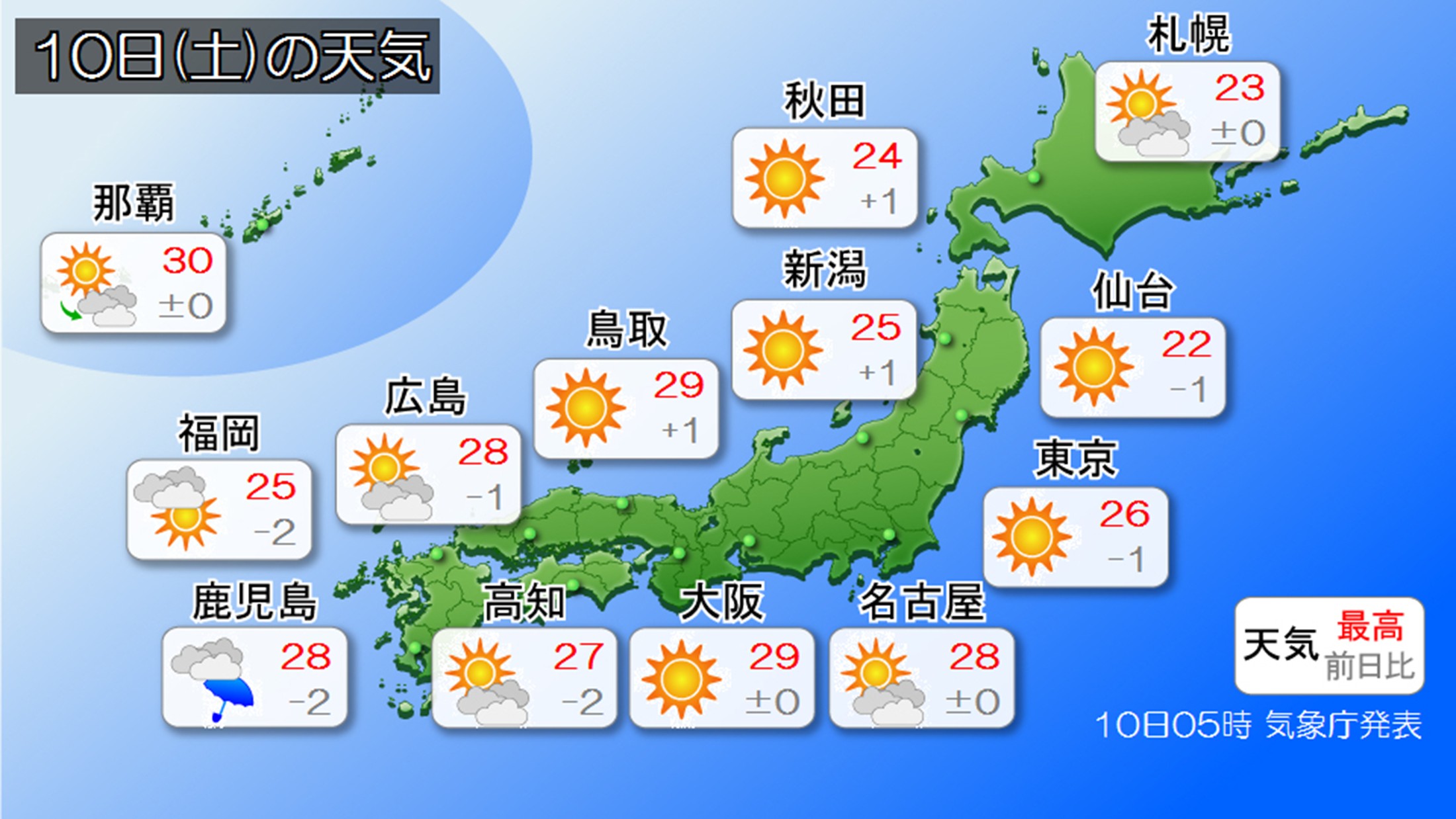
In Hokkaido, clouds will tend to spread over the northern part of the region, with some areas likely seeing rain.
Regions stretching from Tohoku through Chugoku and Shikoku will be gently covered by a high-pressure system, resulting in clear autumn weather. It promises to be an ideal day for leisure activities or hanging laundry outside.
However, due to the influence of Typhoons No. 28 and No. 29, high waves accompanied by swells are expected along the Pacific coast. Please exercise caution if engaging in marine leisure activities.
Kyushu and Okinawa will be under the influence of a pressure trough, leading to weather conditions prone to rain. You will need rain gear if you go out.
Kagoshima Prefecture, in particular, will see an influx of warm, moist air from the periphery of the high-pressure system, making atmospheric conditions unstable. Please be alert for lightning, sudden strong gusts (such as those associated with tornadoes), and sudden heavy downpours.
If you notice signs of approaching developed cumulonimbus clouds-such as hearing thunder or seeing dark clouds drawing near-please prioritize your safety by moving into a sturdy building.
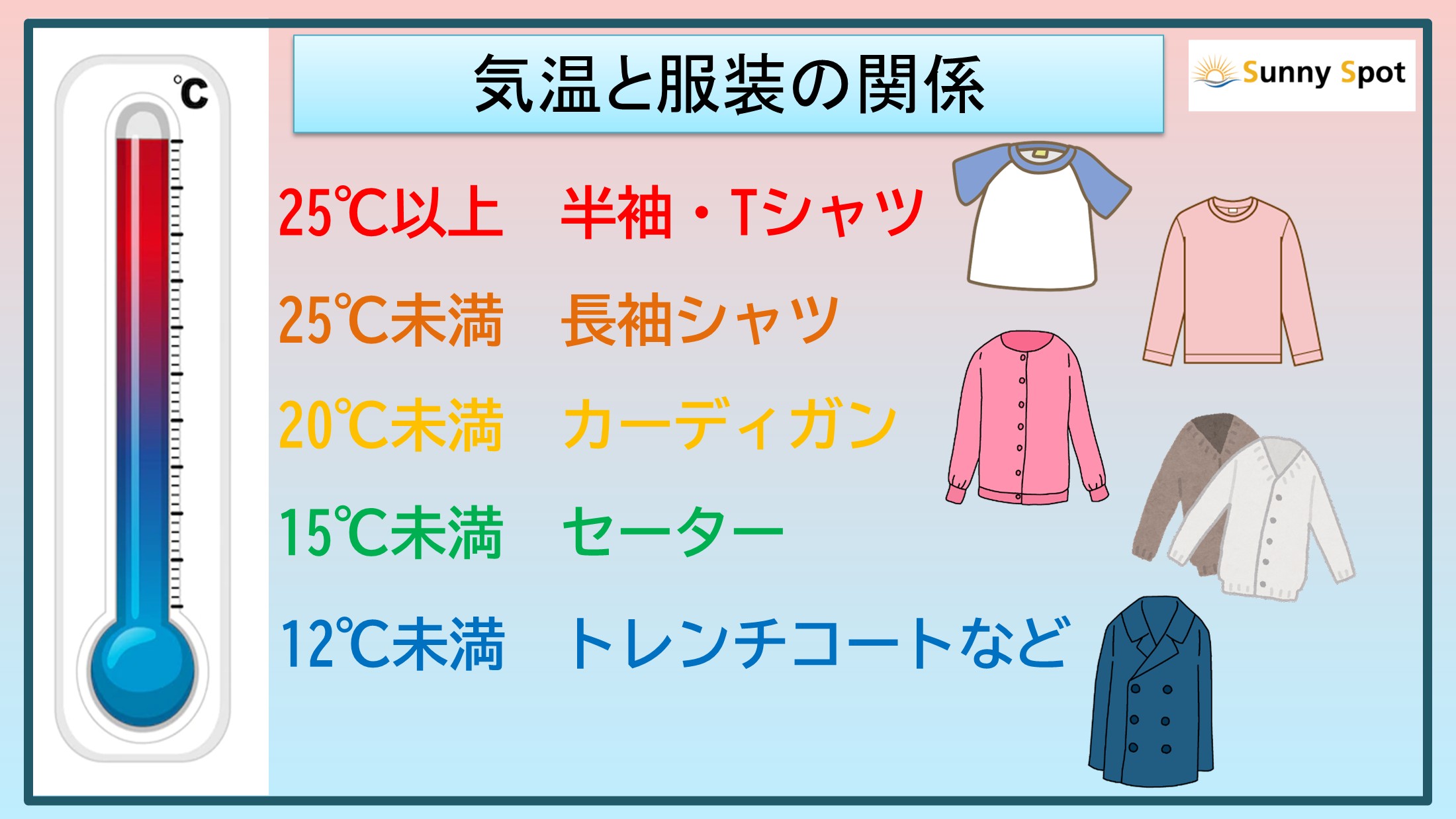
Regarding temperatures, regions with clear skies will experience a significant difference between morning/evening lows and daytime highs. Please adjust your clothing accordingly to avoid falling ill. While individual sensitivity to heat and cold varies, a general guideline is: short sleeves for 25C or higher; long-sleeved shirts when it drops below 25C; and an outer layer, such as a cardigan, when it falls below 20C. It is a good idea to bring an outer layer when you go out so you can adjust your clothing as needed.
Please use this guide on the relationship between temperature and appropriate attire as a reference.