







-
[Weekly Weather] Unsettled weather expected this week due to low-pressure systems and moist air.
2026/10/25 19:57
-
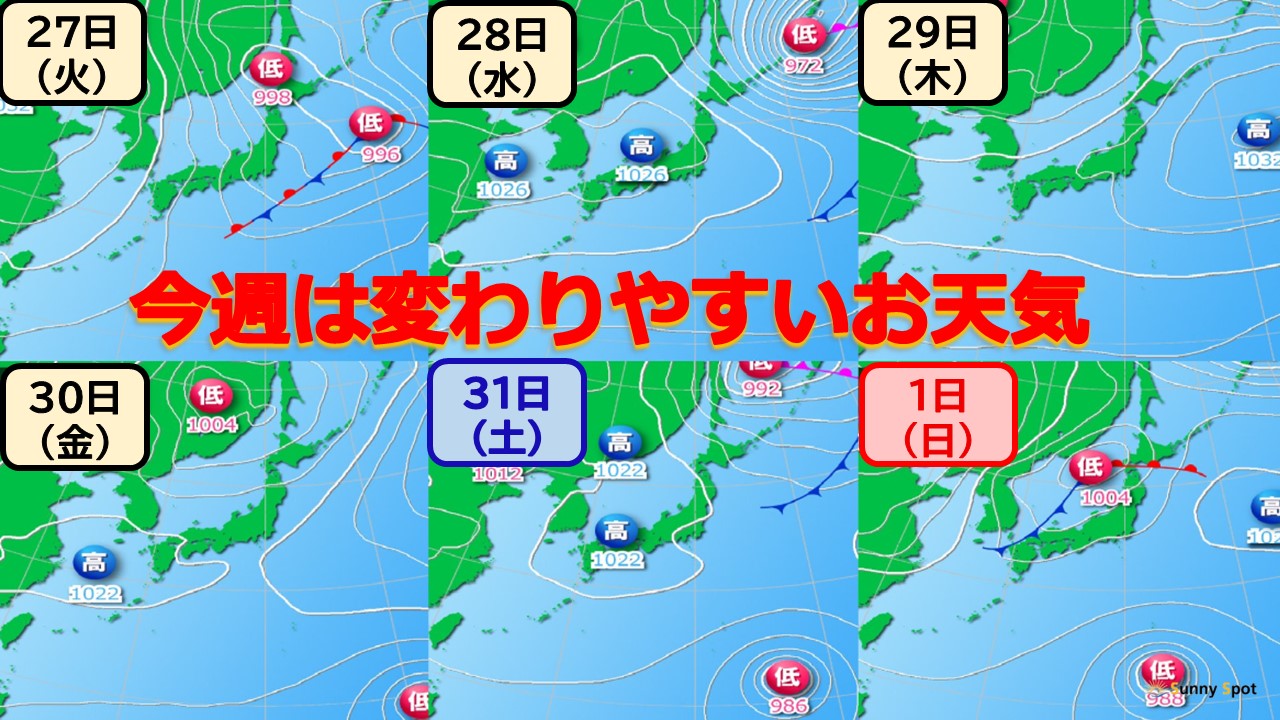
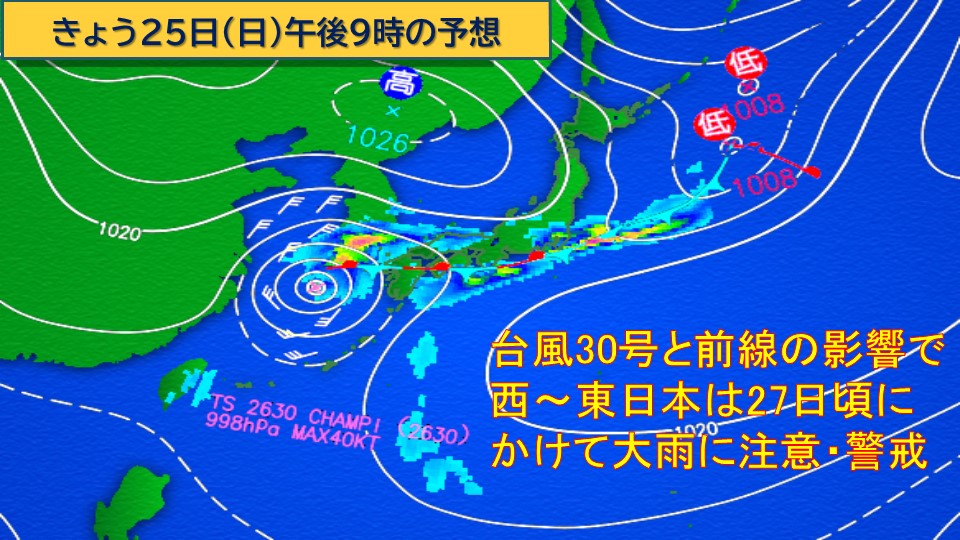
Today, the 25th, a front extending from a low-pressure system east of Japan remains stationary near the southern coast of Honshu.
Typhoon No. 30 is moving northeast across the East China Sea and is approaching this front.
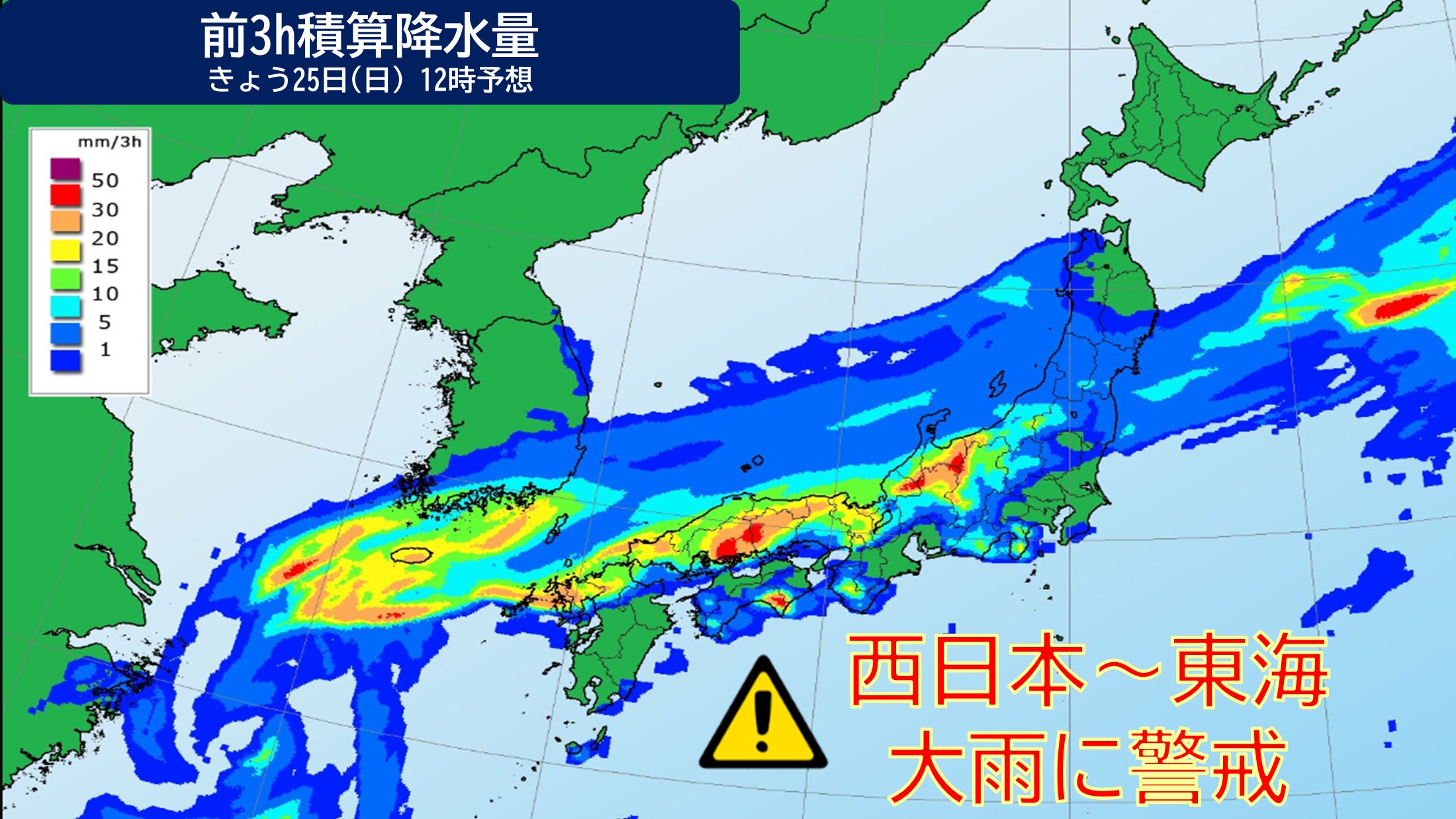
Warm, moist air from the typhoon is flowing toward the front, resulting in heavy rainfall in some areas across eastern and western Japan.
Typhoon No. 30 is expected to continue moving eastward through tomorrow, the 26th, and is projected to transition into an extratropical cyclone by the morning of the 26th.
A new low-pressure system is forming along the front near the Izu Islands; it is expected to intensify as it moves eastward, passing to the east of Japan, through Tuesday the 27th.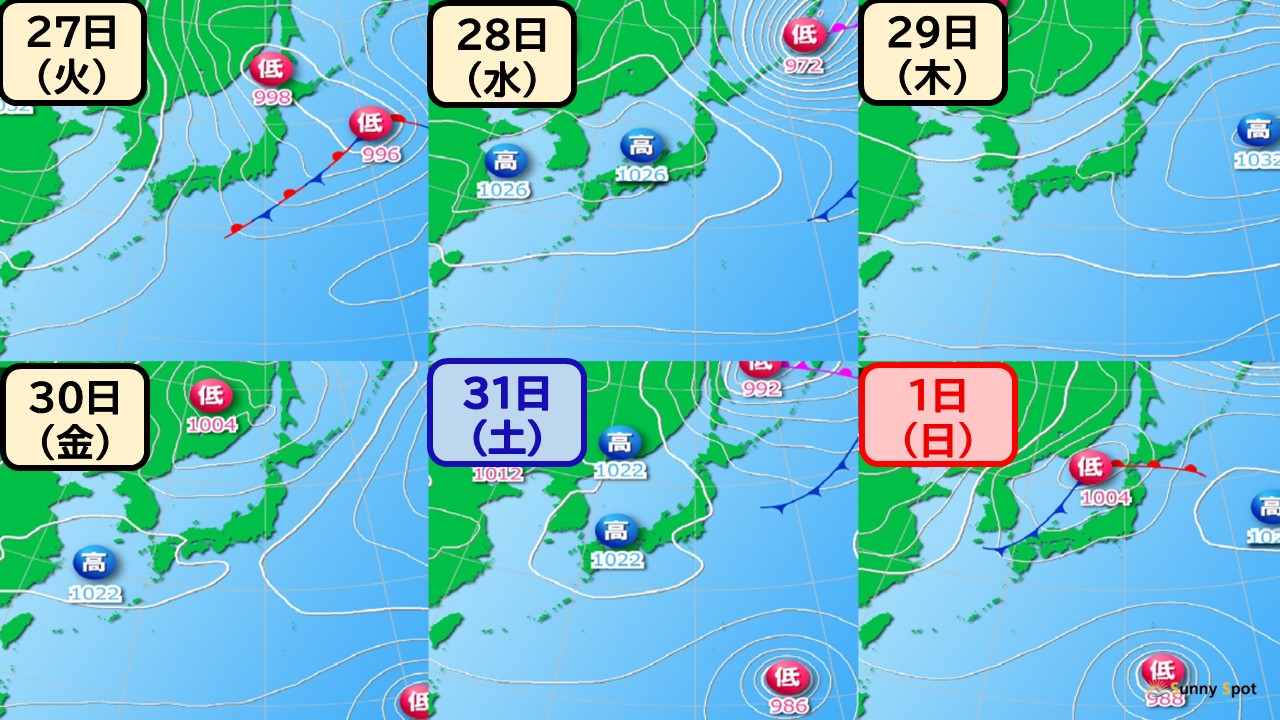
As a result, significant rainfall is expected?particularly across Kyushu and the Pacific-facing regions of western Japan?with some areas likely to experience heavy rain accompanied by thunderstorms.
In eastern Japan, caution is advised through the 27th regarding the potential for lightning strikes, sudden gusts of wind, and localized heavy downpours.
Once the typhoon and low-pressure systems have passed, the weather around Honshu will clear up temporarily on Wednesday and Thursday; however, Hokkaido may see snow due to the influence of a low-pressure system near the Kuril Islands.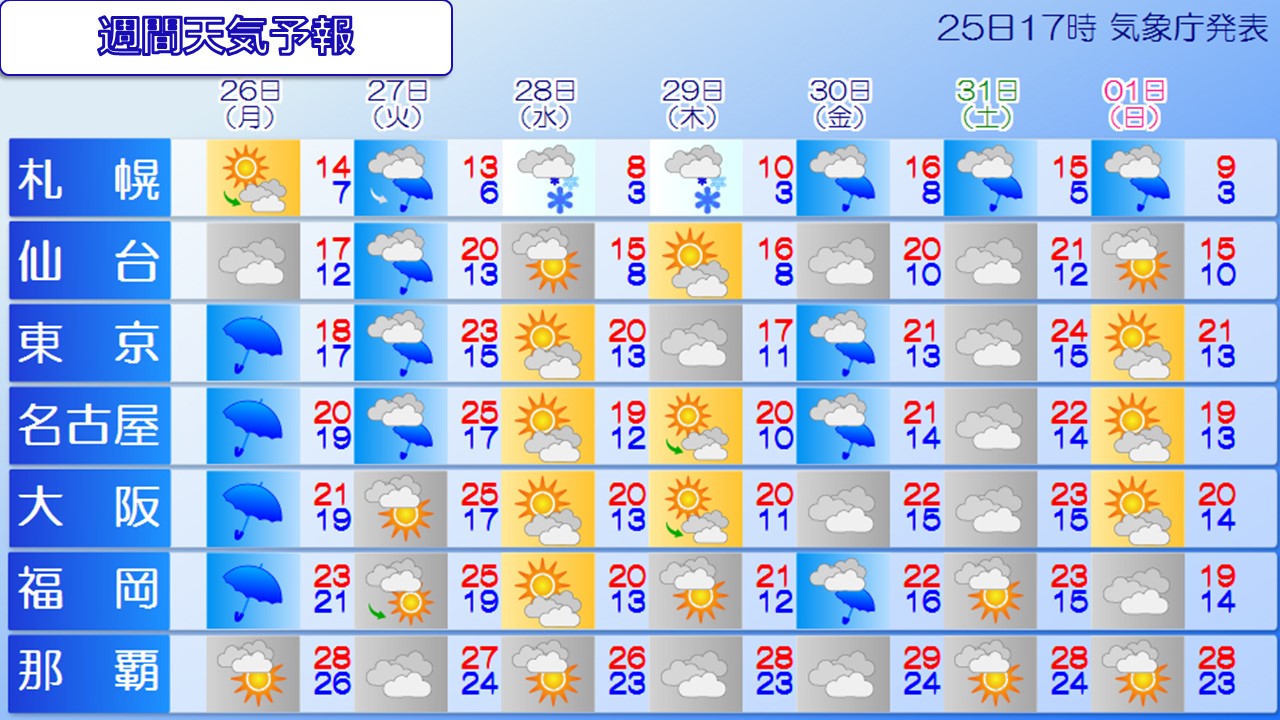
Later in the week, the weather is likely to deteriorate once again across the country.
Please stay alert to the changeable weather conditions and keep an eye on the latest weather forecasts.
-
Weather for tomorrow, Monday the 26th: Rain expected across a wide area from Eastern to Western Japan; be prepared for heavy rain.
2026/10/25 18:00
-
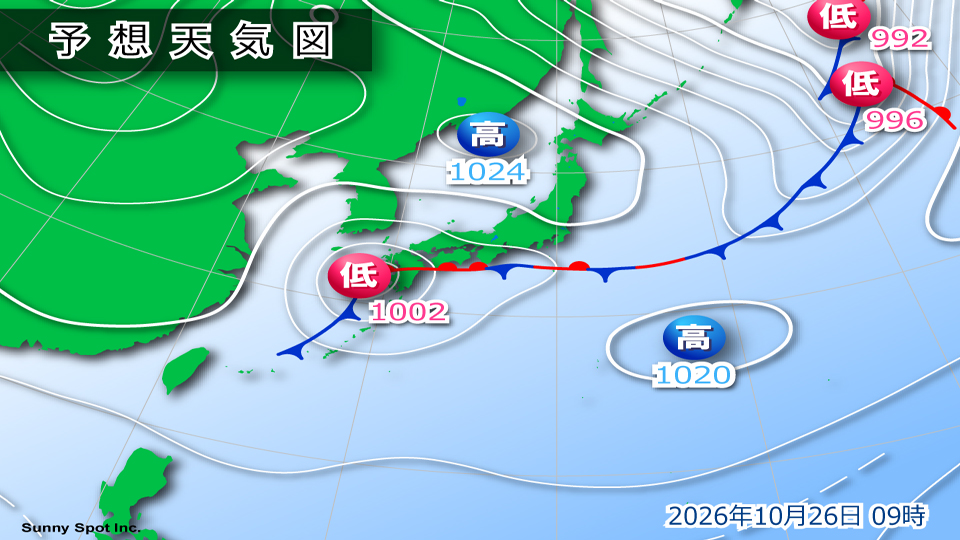
Tomorrow, Monday the 26th?the start of the new week?is expected to see widespread rain across eastern and western Japan due to the influence of a low-pressure system and a front. Meanwhile, northern Japan will largely be under the influence of a high-pressure system, bringing mostly clear skies.
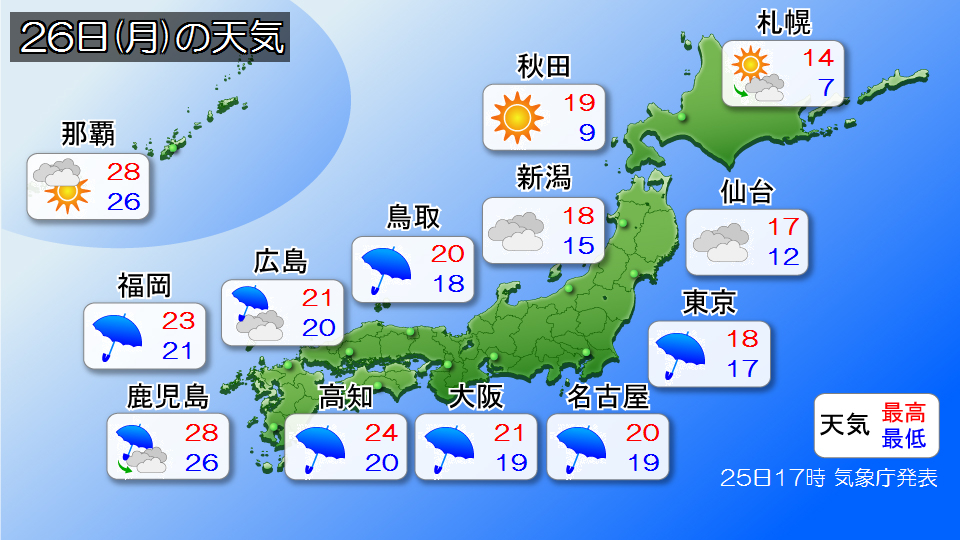
An extratropical cyclone?formerly a typhoon?is expected to pass over western Japan and move toward the waters south of Honshu. As warm, moist air flows in from the south toward this low-pressure system and front, rain clouds are expected to intensify. In western Japan, in particular, there is a risk of heavy rainfall, with localized downpours potentially reaching 30mm or more?and in some areas, even 50mm or more?per hour. Please remain on alert for landslides, rising river levels, flooding, and the inundation of low-lying areas.
Northern Japan will be under a high-pressure system, with mostly clear weather. In the southern part of the Tohoku region, however, there is a chance of scattered showers by the afternoon, so it would be wise to carry a folding umbrella.
Temperatures in many areas will be lower than they were today (the 25th), and it may feel chilly throughout the day. Please dress warmly when heading out.
-
[Typhoon Information] Heavy rain expected across western to eastern Japan due to Typhoon 30 and a frontal system.
2026/10/25 13:29
-
As of 12:00 PM today, Sunday the 25th, Typhoon No. 30 (Champa) is located over the East China Sea, moving northeast at a speed of approximately 20 km/h. The central pressure is 996 hPa, with maximum sustained winds of 20 m/s near the center and maximum gusts of 30 m/s. Strong winds of 15 m/s or greater are occurring within 560 km to the northeast and 330 km to the southwest of the center.
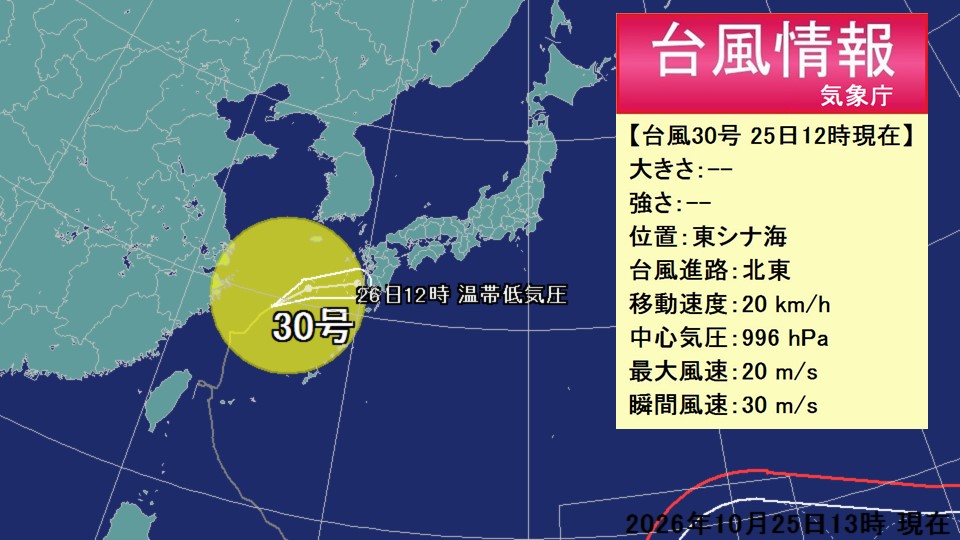
# Typhoon No. 30 ? Sunday, the 25th, 12:00 PM
-----------------------------------
Center Location: East China Sea
Movement: Northeast at 20 km/h
Central Pressure: 996 hPa
Maximum Sustained Winds: 20 m/s (near the center)
Maximum Gusts: 30 m/s
-----------------------------------
Typhoon No. 30 is expected to continue moving northeast across the East China Sea and will likely transition into an extratropical cyclone to the west-northwest of Makurazaki City by tomorrow, Monday the 26th. After transitioning into an extratropical cyclone, it is expected to move eastward along the southern coast of Honshu.
In the northern Kyushu region, through tomorrow, Monday the 26th, please remain on high alert for landslides, flooding in low-lying areas, and rising water levels or overflowing of rivers. Additionally, please be cautious of violent winds and high waves accompanied by swells throughout the day tomorrow, Monday the 26th.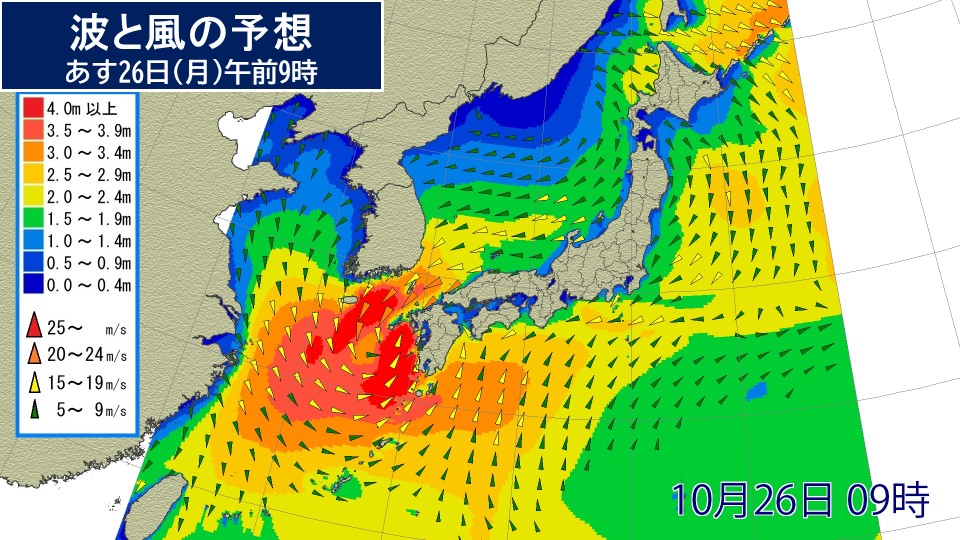
Additionally, a weather front extends from the East China Sea, across western and eastern Japan, and toward the east of Japan. This front is expected to shift southward, reaching the Pacific coast of western and eastern Japan by tomorrow, Monday the 26th. By tomorrow, Monday the 26th, Typhoon No. 30 is expected to transition into a low-pressure system along this front and move eastward.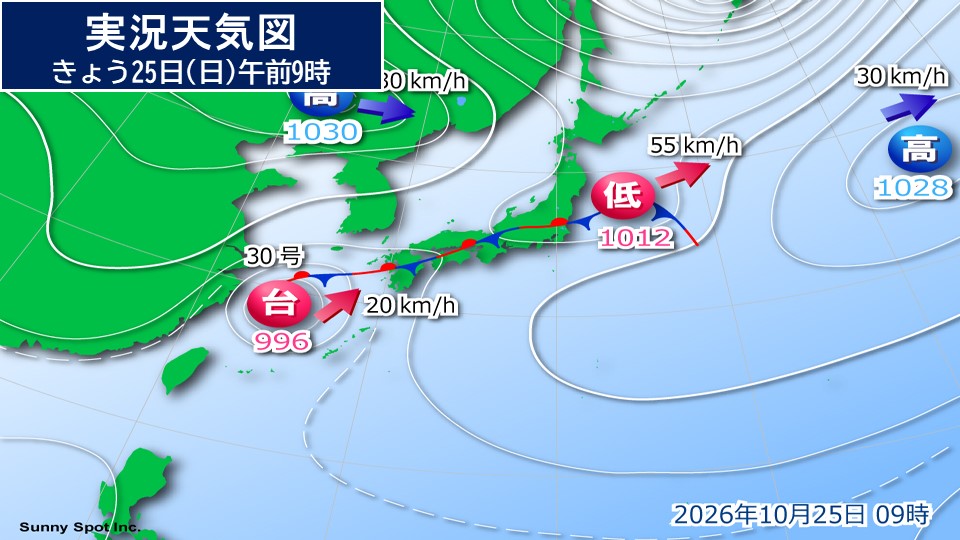
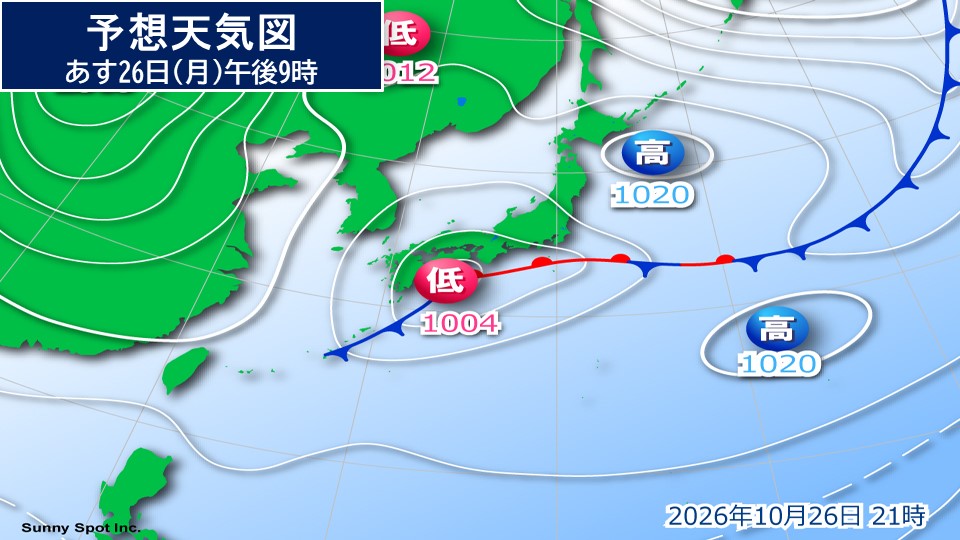
Warm, moist air-flowing northward from the vicinity of the typhoon and the Pacific high-pressure system-will feed into the front, causing it to become more active. Please remain alert and take precautions against landslides, flooding in low-lying areas, and rising river levels in western Japan through Monday the 26th, and in eastern Japan through Tuesday the 27th.
In western Japan, please also remain alert and take precautions against storm surges on Monday the 26th.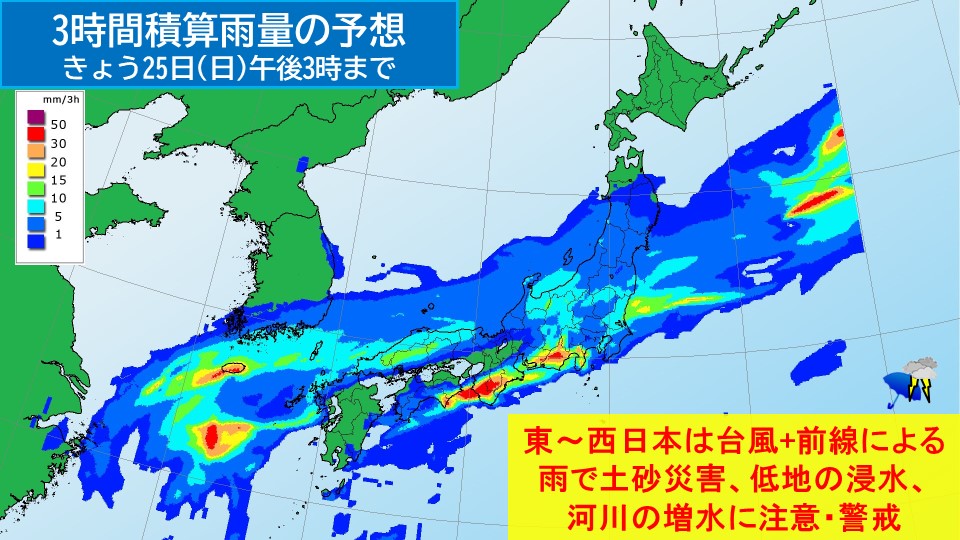
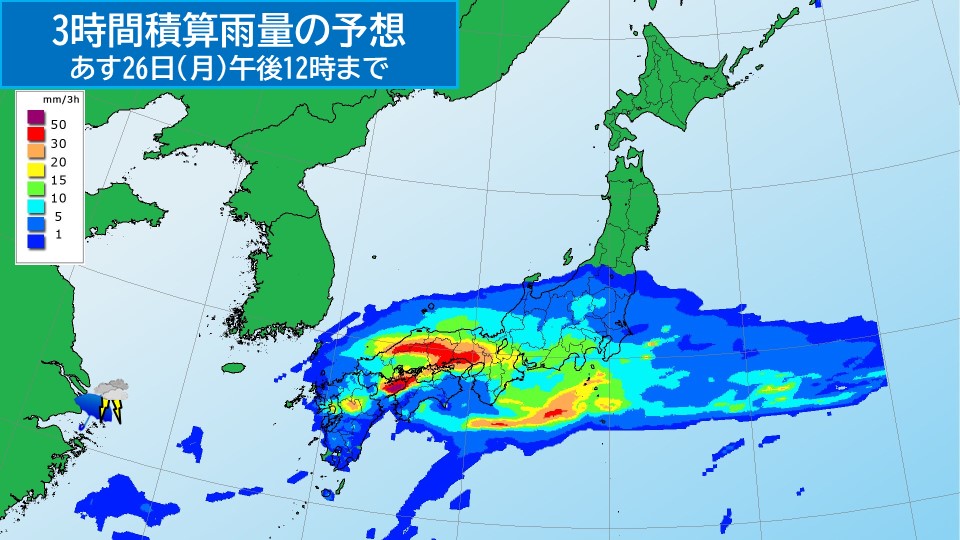
Please stay updated with the latest disaster-prevention weather information.
Additionally, please regularly check the risk level for your area using the Japan Meteorological Agency's "Kikikuru" (a tool showing the distribution of risks for landslides, inundation, and flooding) on ??their website.
-
Weather for tomorrow, Thursday the 23rd: Conditions to deteriorate from the west; Okinawa region urged to stay on alert for a typhoon.
2026/10/25 07:53
-
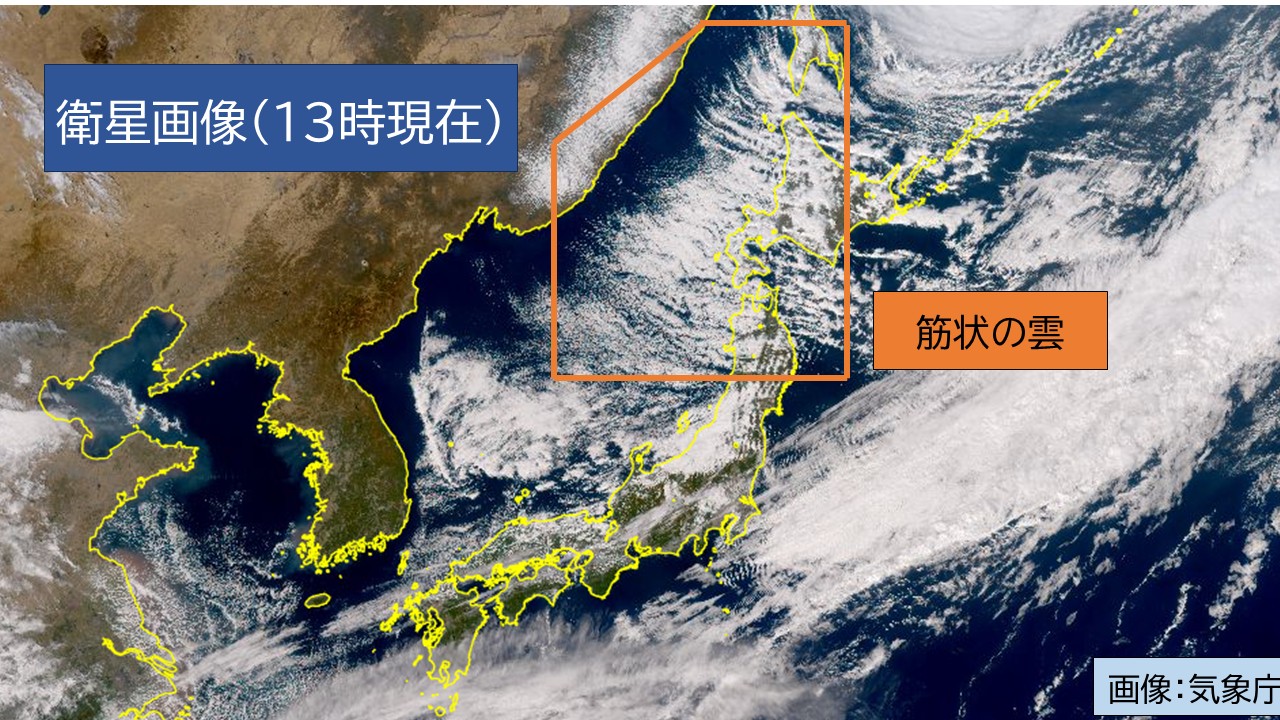
As of 11:00 a.m. today, Thursday the 22nd, a migratory high-pressure system is covering much of western Japan, bringing clear autumn weather to a wide area around Honshu. Meanwhile, in northern Japan, a "west-high, east-low" pressure pattern has developed; cold air?with temperatures of -6C or lower at an altitude of approximately 1,500 meters-is flowing over the waters west of Hokkaido. Over the Sea of ??Japan, "banded clouds"-a characteristic feature of winter-have formed.
Additionally, a large and violent Typhoon No. 30 is moving west-northwest south of Okinawa, and a high-wave warning has been issued for the Okinawa region. Please stay alert and keep track of the latest information regarding this typhoon.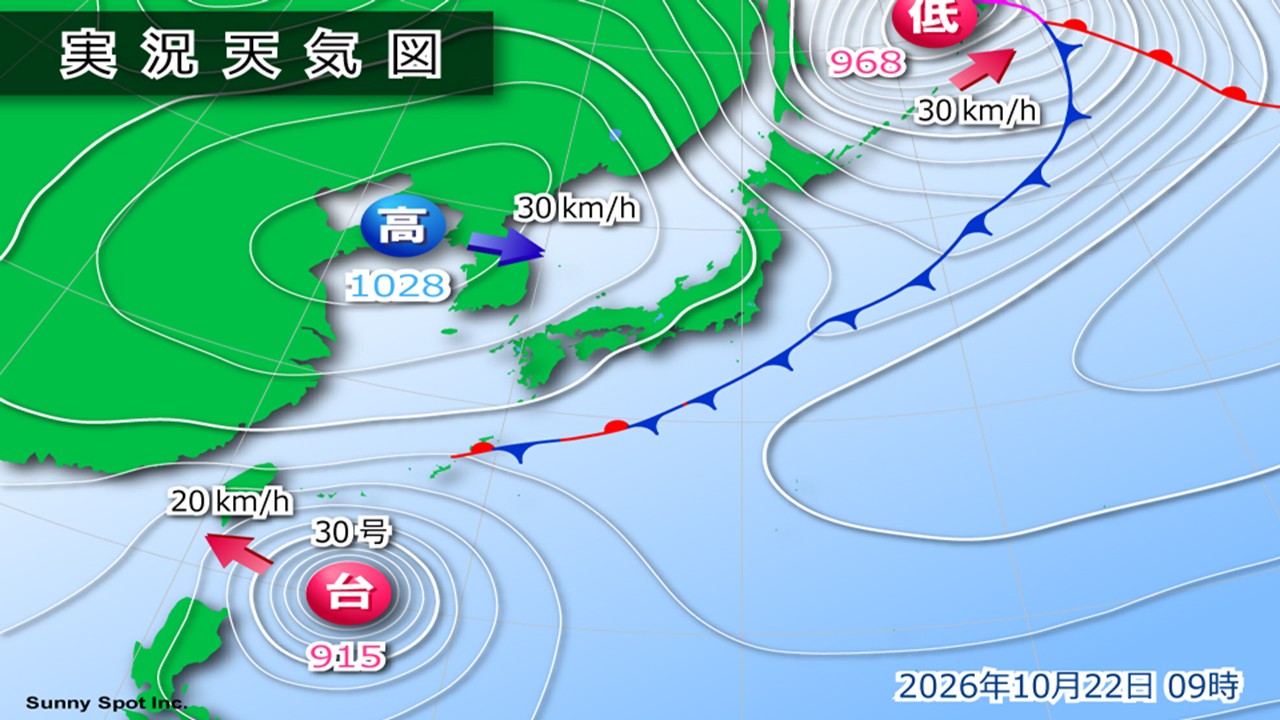
Detailed Weather Forecast by Region (for tomorrow, the 23rd)
Okinawa Region: Typhoon No. 30 Approaching ? High Alert for Violent Winds and Heavy Rain in the Sakishima Islands
Typhoon No. 30 is expected to approach the Sakishima Islands with "very strong" intensity between tomorrow, Friday the 23rd, and the following day, Saturday the 24th. The Sakishima Islands will experience violent winds during this period?strong enough to potentially cause the collapse of some homes. Please move into a sturdy building and stay away from windows; remain on high alert against these severe winds. Furthermore, heavy, warning-level rainfall is expected from tomorrow, Friday the 23rd, through Saturday the 24th. Remain on high alert for landslides, flooding in low-lying areas, and rising or overflowing rivers. Caution is also advised regarding high waves-accompanied by swells?in areas including the Okinawa main island region and the Daito Islands. Depending on the typhoon's path, there is a risk of warning-level storm surges from tomorrow, Thursday the 23rd, through around Saturday the 25th. Please exercise extreme caution regarding flooding or inundation in low-lying areas near coastlines and river mouths.
Western and Eastern Japan: Sunny spells in the morning, but rain and clouds expected across a wide area by evening
While many places will see sunny skies this morning under the influence of a high-pressure system, areas around Kagoshima Today, Sunday the 25th, Typhoon No. 30 is moving northward over the East China Sea, while a stationary front remains in the vicinity of Honshu. Caution is advised, as there is a risk of localized, heavy rainfall across western and eastern Japan.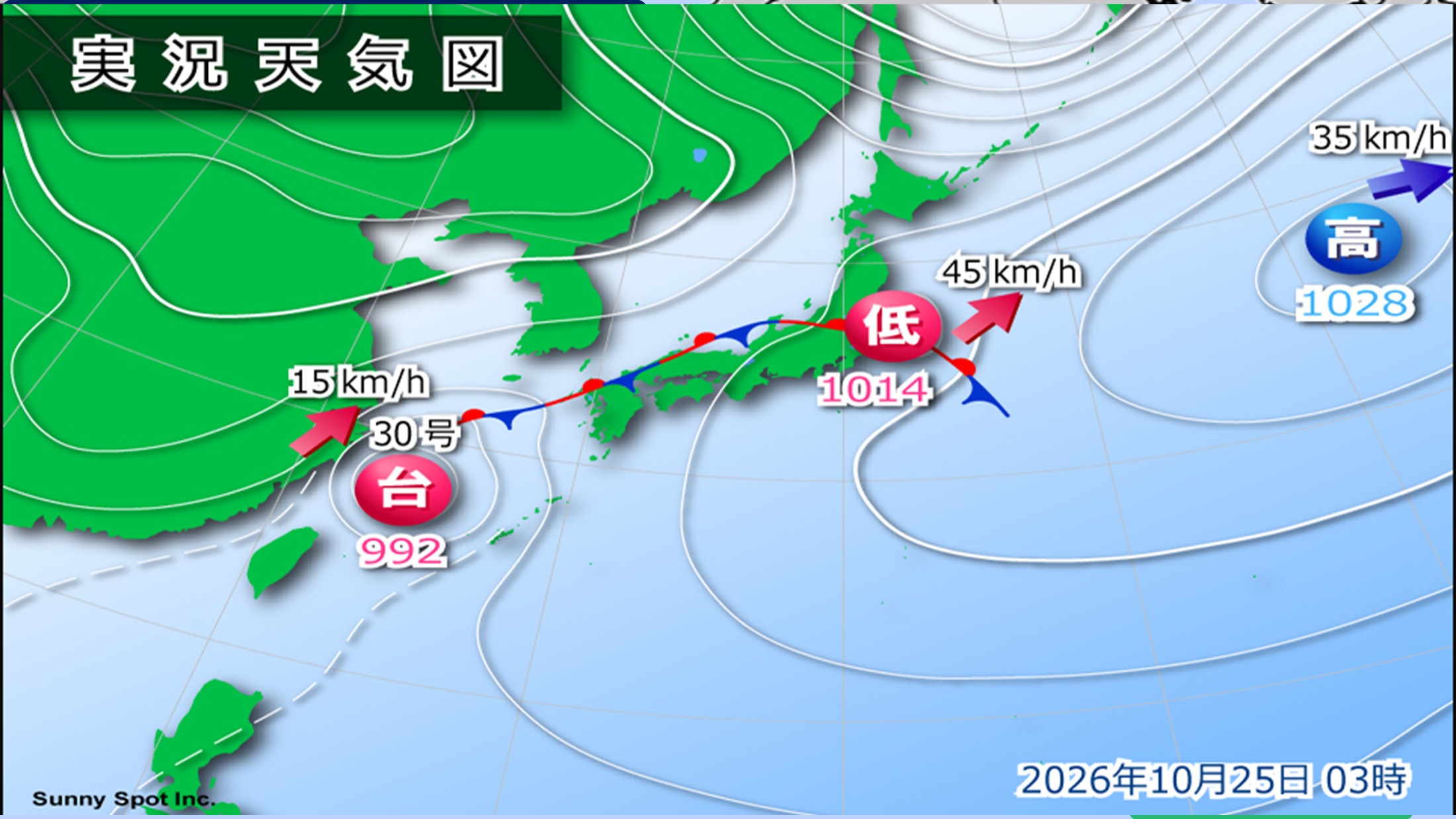
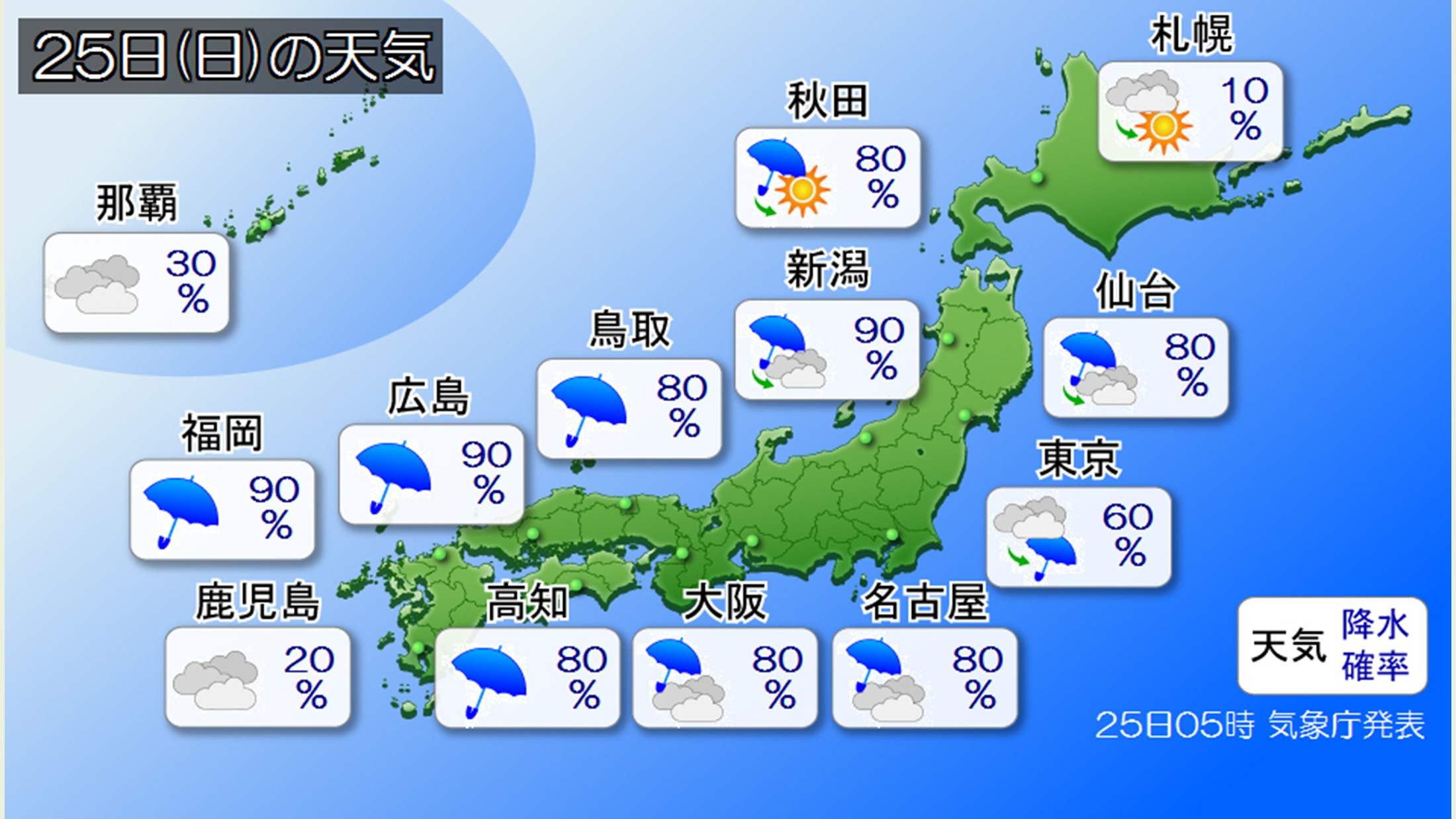
The warm, moist air brought by Typhoon No. 30 is intensifying the front. From western Japan through the Tokai region, rain clouds are expected to develop?initially along the Sea of ??Japan coast this morning, and spreading to the Pacific coast by the afternoon. Some areas may experience intense, localized downpours. Please remain on alert for flooded roads, inundation in low-lying areas, and landslides.
Rain will also begin this morning in the Hokuriku and Tohoku regions, with the potential for heavier rainfall in parts of Hokuriku. Rain will gradually spread to the Kanto region as well; be sure to carry rain gear if you are heading out.
Meanwhile, Hokkaido will be under the influence of a high-pressure system, with some periods of sunshine expected, particularly along the Pacific coast.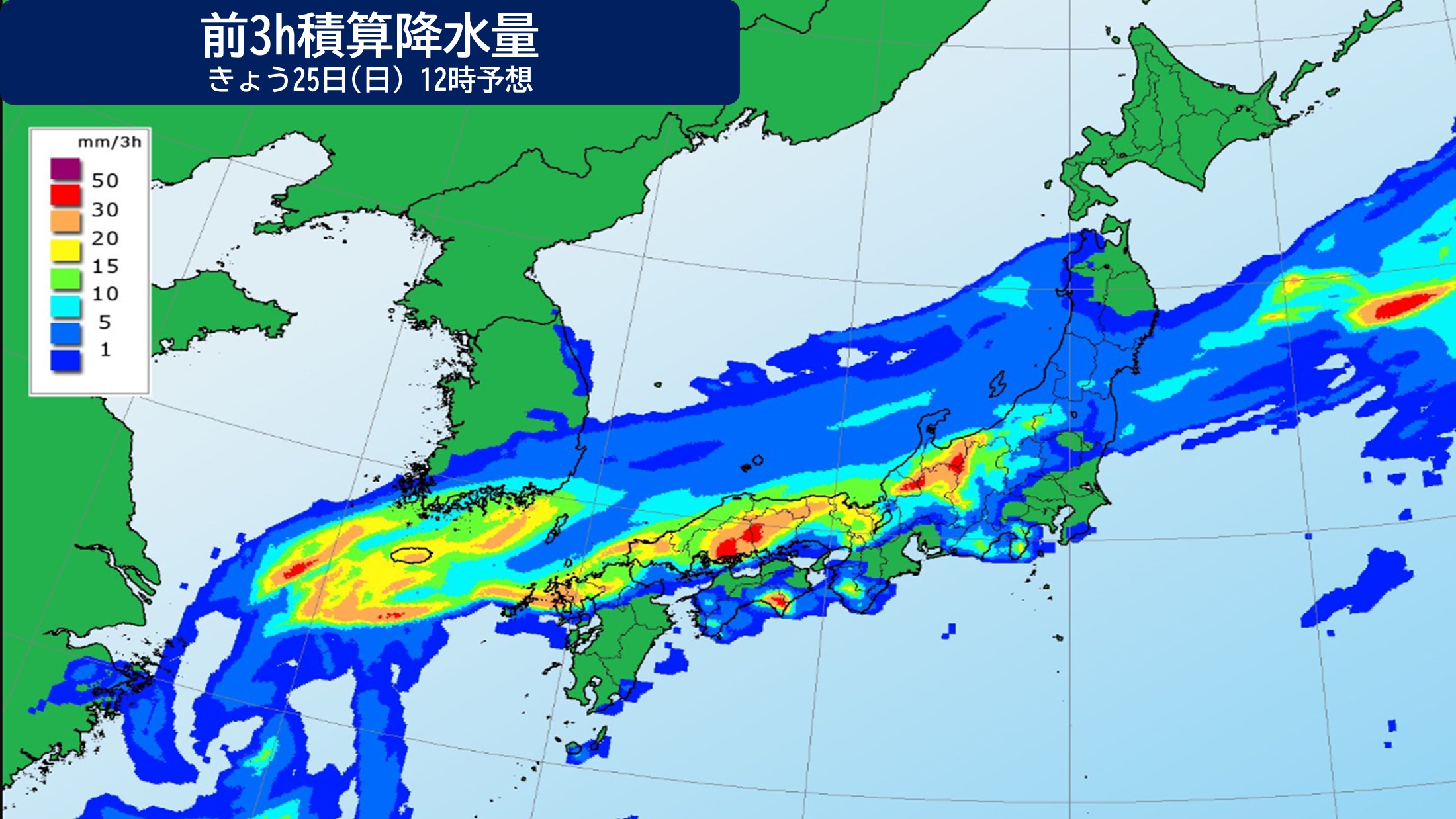
The projected rainfall for each region is as follows: The maximum expected 24-hour rainfall between 6:00 AM on the 25th and 6:00 AM on the 26th is as follows:
Kanto-Koshin Region: 80 mm
Hokuriku Region: 80 mm
Tokai Region: 60 mm
Kinki Region: 100 mm
Chugoku Region: 120 mm
Shikoku Region: 150 mm
Northern Kyushu: 200 mm
Southern Kyushu: 100 mm
Subsequently, the maximum expected 24-hour rainfall between 6:00 AM on the 26th and 6:00 AM on the 27th is as follows:
Kanto-Koshin Region: 200 mm
Hokuriku Region: 60 mm
Tokai Region: 150 mm
Kinki Region: 150 mm
Chugoku Region: 80 mm
Shikoku Region: 200 mm
Northern Kyushu: 100 mm
Southern Kyushu: 100 mm
Furthermore, in Western Japan, please be cautious of lightning strikes and severe gusts, such as those associated with tornadoes. If there are signs that a developed cumulonimbus cloud is approaching, please take steps to ensure your safety, such as by moving indoors.
-
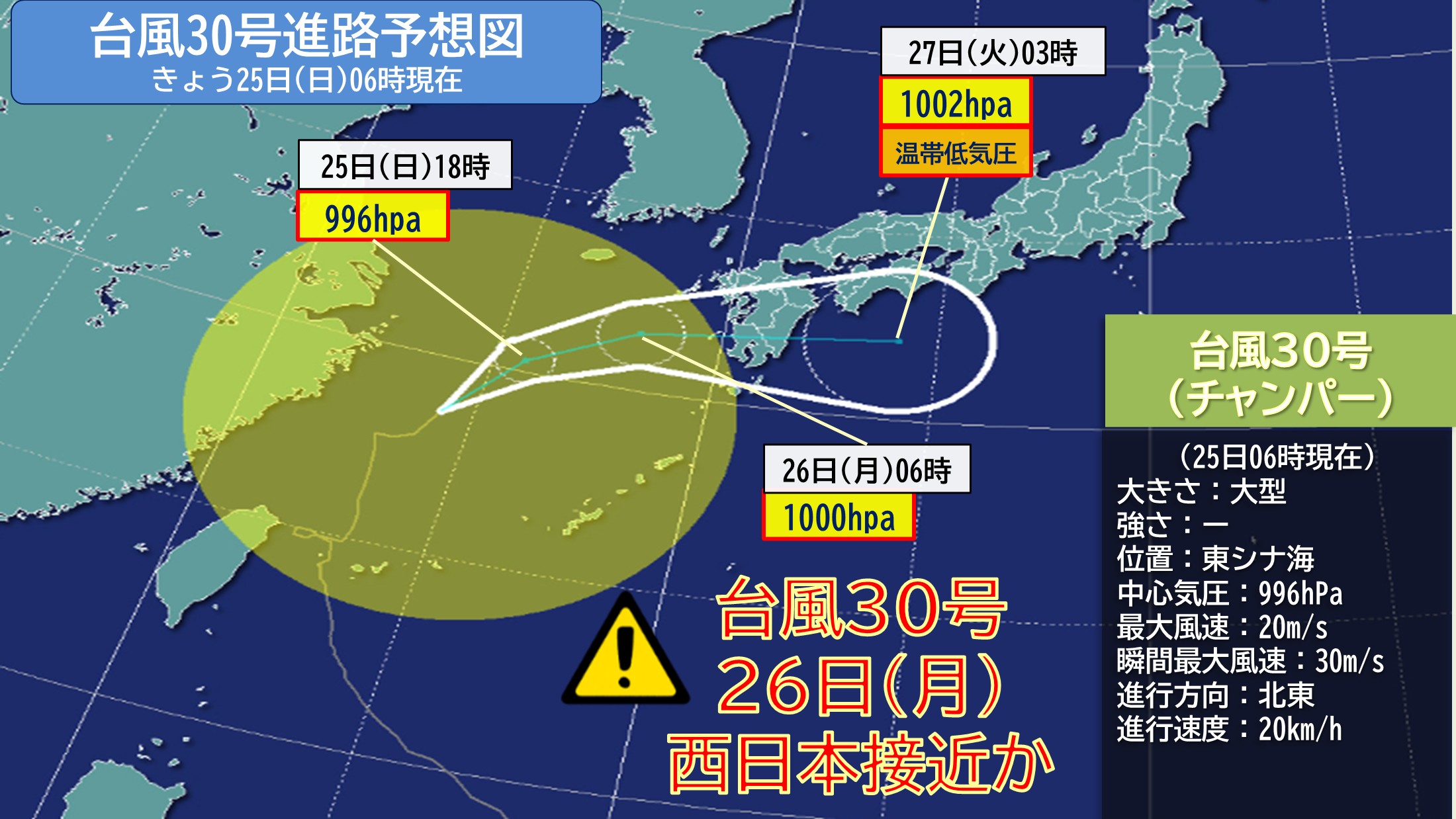
[Typhoon Information] Large Typhoon No. 30 is expected to approach Western Japan on Monday the 26th; there is a risk of heavy, warning-level rainfall across a wide area from Western to Eastern Japan. and alert through around the 27th.
2026/10/25 07:13
-
Additionally, a front extends from the East China Sea, passing near Western Japan and reaching east of Japan. Through tomorrow, Monday the 26th, this front is expected to stretch across Western and Eastern Japan. Residents in these regions should remain alert and take precautions against heavy rainfall caused by the front, even befre the typhoon itself approaches.
Typhoon No.30 6::00 AM
Size: Large
Center Location: East China Sea
Movement: Northeast at 20 km/h
Central Pressure: 996 hPa
Maximum Sustained Wind Speed: 20 m/s (near the center)
Maximum Instantaneous Wind Speed: 30 m/s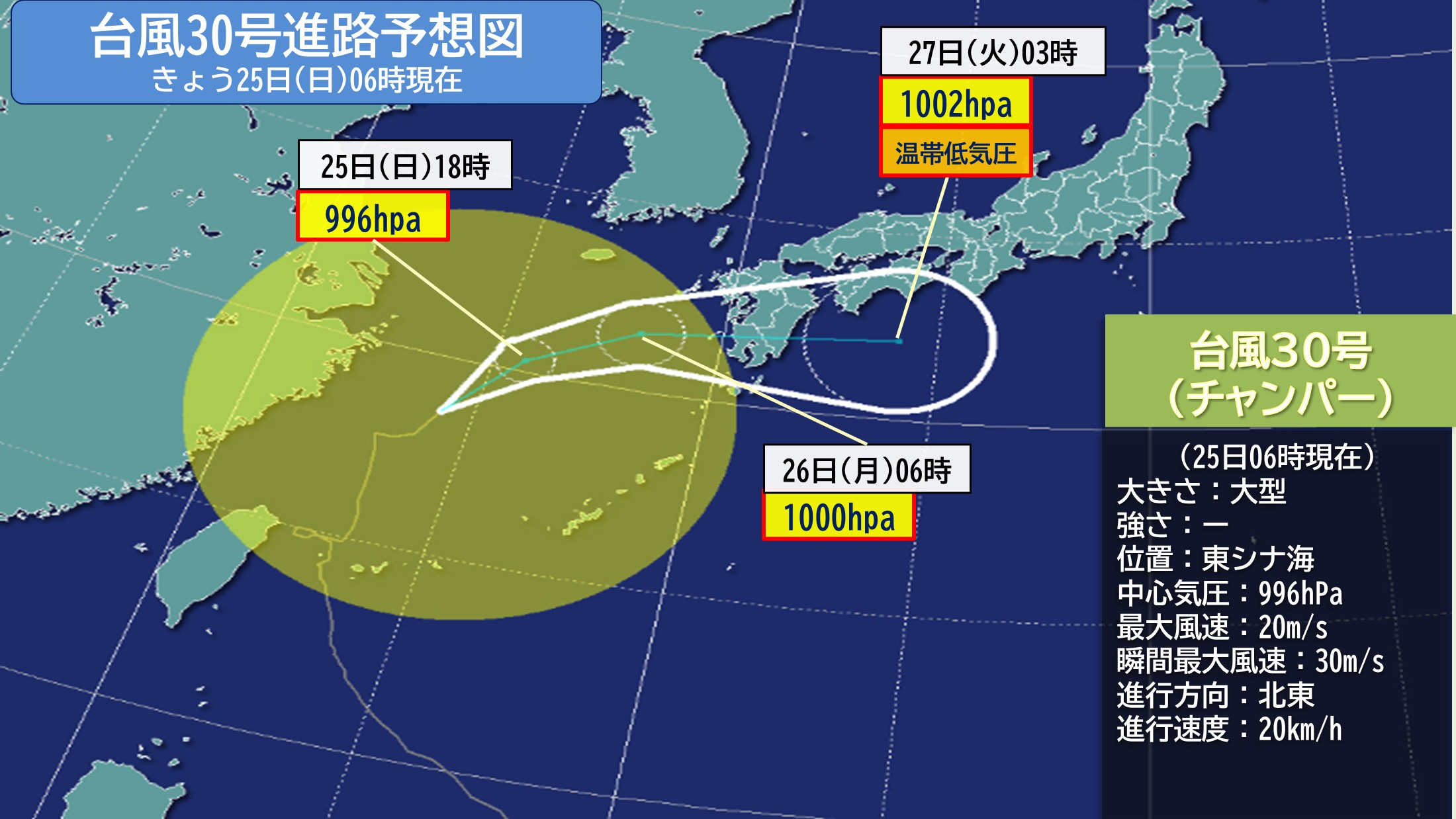
A front extends to the north of the typhoon. Warm, moist air from around the typhoon will flow toward this front, causing it to become more active. Furthermore, Typhoon No. 30 is expected to transition into an extratropical cyclone while moving eastward along the southern coast of Honshu, eventually reaching the waters east of Japan by around Tuesday, the 27th. Consequently, rain is expected to persist across a wide area of ??Western and Eastern Japan through around Tuesday, the 27th. In some locations, the rain may be intense and accompanied by thunderstorms, potentially reaching levels that warrant weather warnings. Please remain vigilant and take precautions against landslides, flooding in low-lying areas, and rising river levels. Additionally, winds will strengthen along the coast, leading to rough weather, and sea conditions may become turbulent in some areas.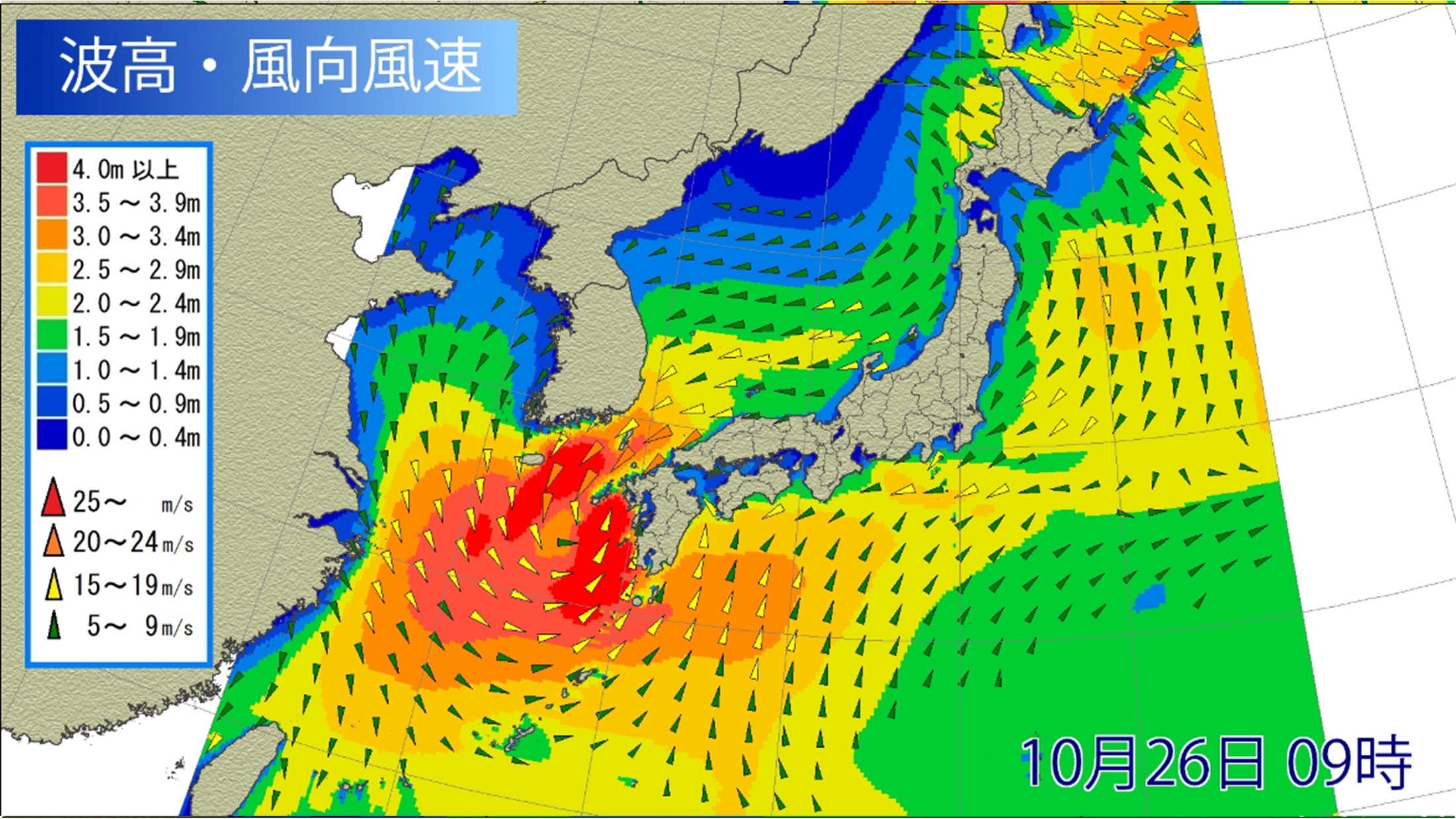
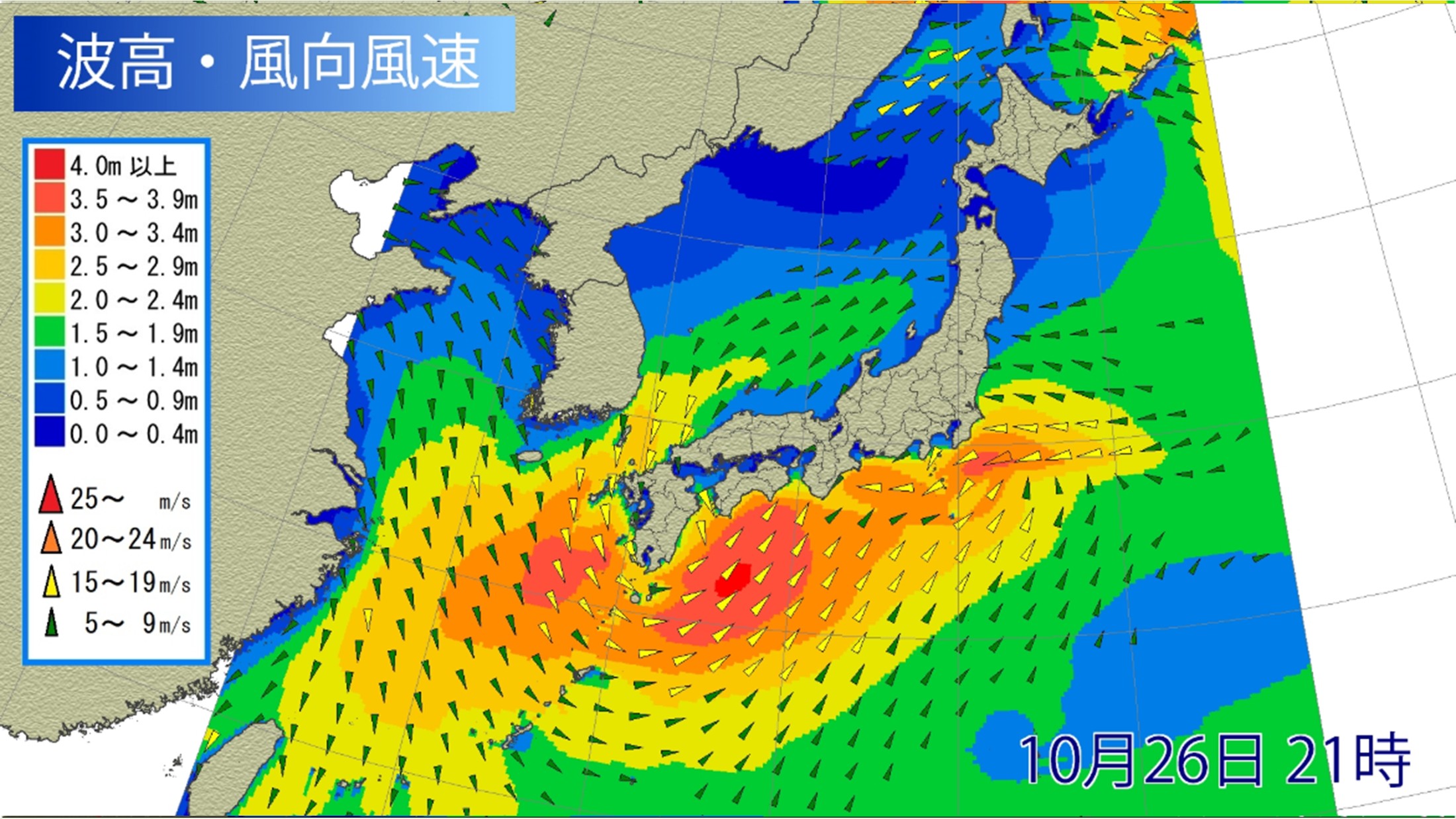
Please note that there is some uncertainty regarding the position of the weather front and the projected path of the typhoon; therefore, be sure to check the latest weather information.
Furthermore, please regularly monitor the risk level for your area using the Kikikuru (hazard distribution maps for landslides, inundation, and flooding) available on the Japan Meteorological Agencys website.
-
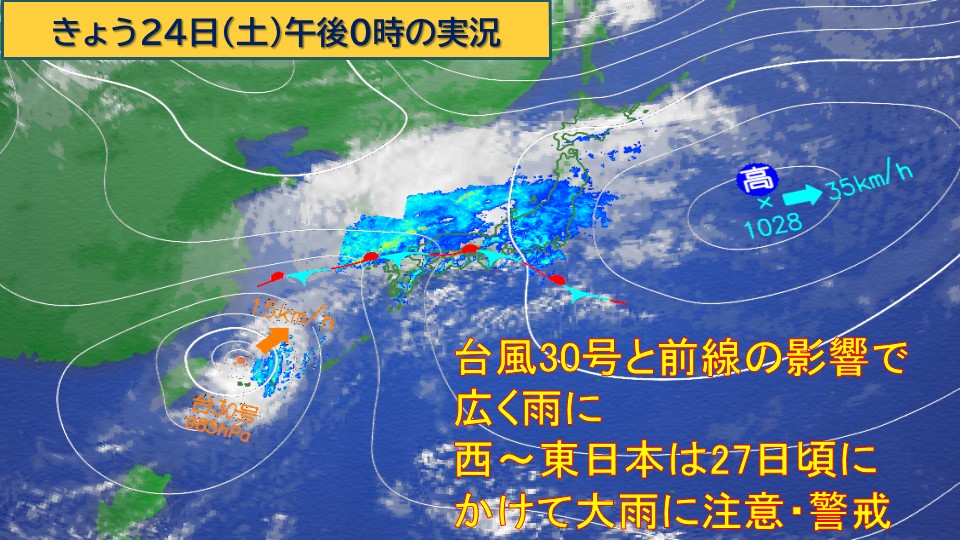
Due to Typhoon No. 30 and a frontal system, there is a risk of heavy, warning-level rainfall across western to eastern Japan; please remain cautious and alert through around the 27th.
2026/10/24 16:43
-
As of 3:00 p.m. today, Saturday the 24th, the large Typhoon No. 30 (Champa) is located north of Yonaguni Island. It is moving north-northeast at a speed of approximately 20 km/h and is accompanied by a zone of violent winds. The central pressure is 985 hPa, with maximum sustained winds of 30 m/s near the center and peak gusts of 40 m/s. A zone of violent winds-with sustained speeds of 25 m/s or greater-extends 150 km to the southeast and 110 km to the northwest of the center.
Typhoon No. 30 is expected to move northward across the East China Sea, then gradually shift its course from a northerly to a more easterly direction by tomorrow, Sunday the 25th. On Monday the 26th, it will approach Western Japan before moving south of Shikoku by the evening, at which point it is expected to transition into an extratropical cyclone.
In the Okinawa region, please remain on high alert for high waves (accompanied by swells), violent winds, landslides, flooding in low-lying areas, and rising or overflowing rivers.
Additionally, a frontal system currently extends from the East China Sea, across Western Japan, and toward the waters south of Japan. This front is expected to move northward toward Eastern Japan by tonight, and subsequently stretch across Western Japan and Eastern Japan through Monday the 26th. Regions from Western to Eastern Japan should exercise caution and remain on alert for heavy rainfall caused by this front, even before the typhoon itself approaches.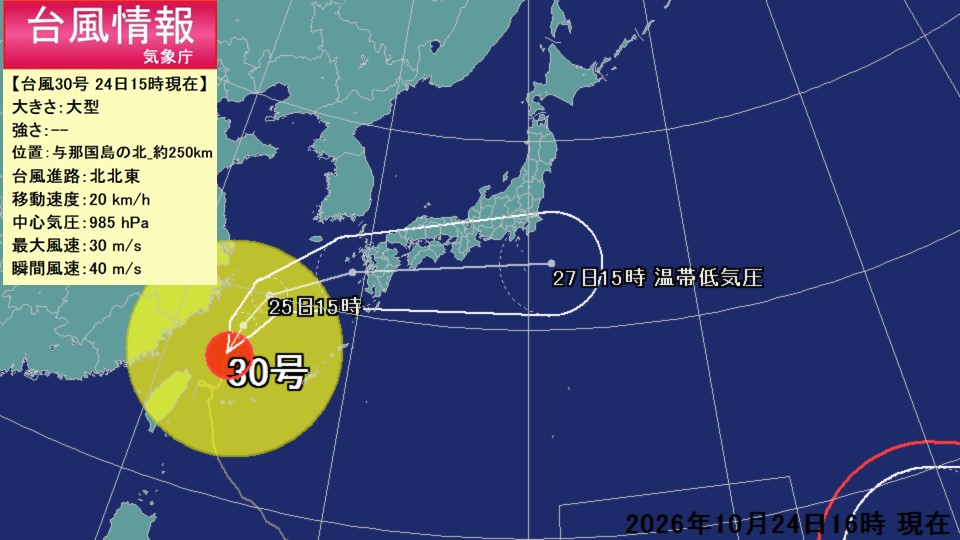
# Typhoon No. 30 ? Saturday, the 24th, 3:00 PM
------------------------------------
Size: Large
Center location: Approx. 250 km north of Yonaguni Island
Movement: North-northeast at 20 km/h
Central pressure: 985 hPa
Maximum sustained wind speed: 30 m/s (near the center)
Maximum instantaneous wind speed: 40 m/s
------------------------------------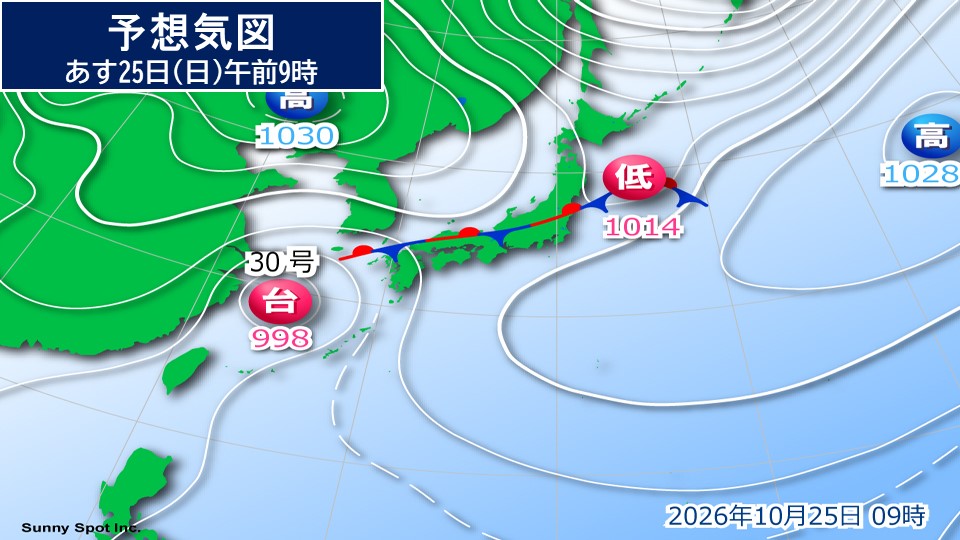
A weather front extends to the north of the typhoon. Warm, moist air from around the typhoon is flowing toward this front, which will likely intensify its activity. Furthermore, Typhoon No. 30 is expected to transition into an extratropical cyclone around Tuesday, the 27th, while located off the coast of the Tokai region or to the east of Japan. Consequently, rain is expected to persist across a wide area of ??western and eastern Japan through around Tuesday, the 27th. In some locations, the rain may become heavy-potentially reaching warning-level intensity-and could be accompanied by thunderstorms. Please remain alert and take precautions against landslides, flooding in low-lying areas, and rising water levels in rivers.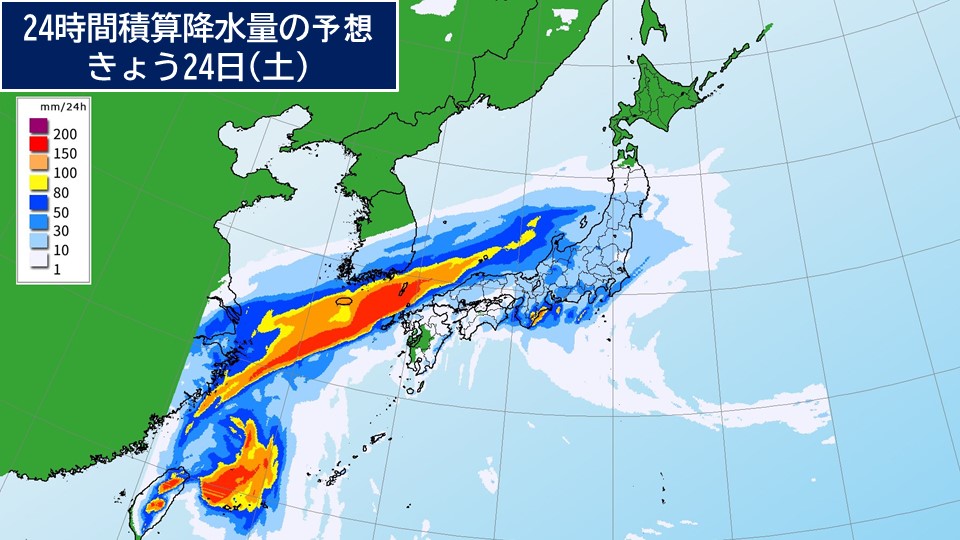
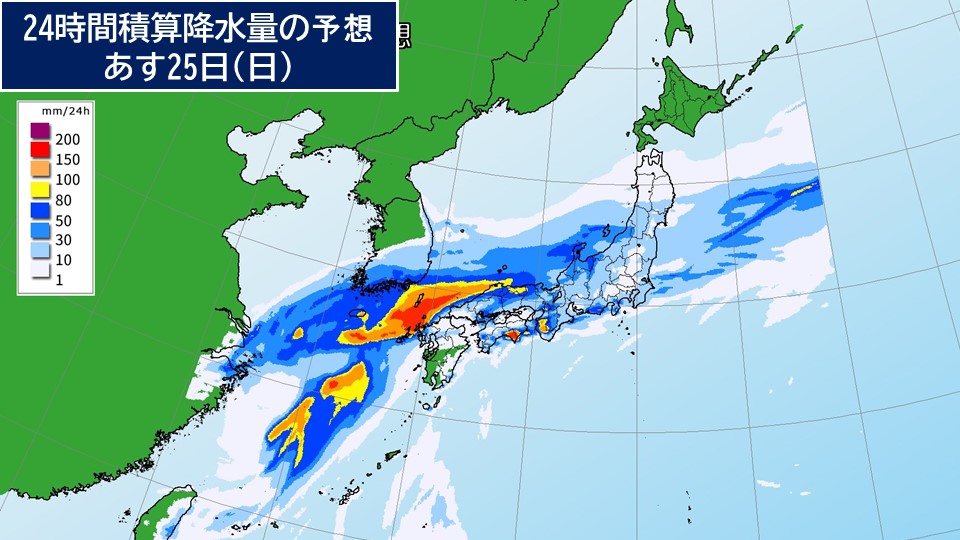
Please note that there is some uncertainty regarding the exact position of weather fronts and the projected path of typhoons; therefore, please be sure to check the latest weather information.
Additionally, please regularly monitor the risk level for your area using the "Kikikuru" (risk distribution maps for landslides, inundation, and flooding) available on the Japan Meteorological Agency's website.
-
Typhoon 31 (In-fa) has formed—the first such occurrence in 13 years; please stay tuned for further updates.
2026/10/24 07:38
-
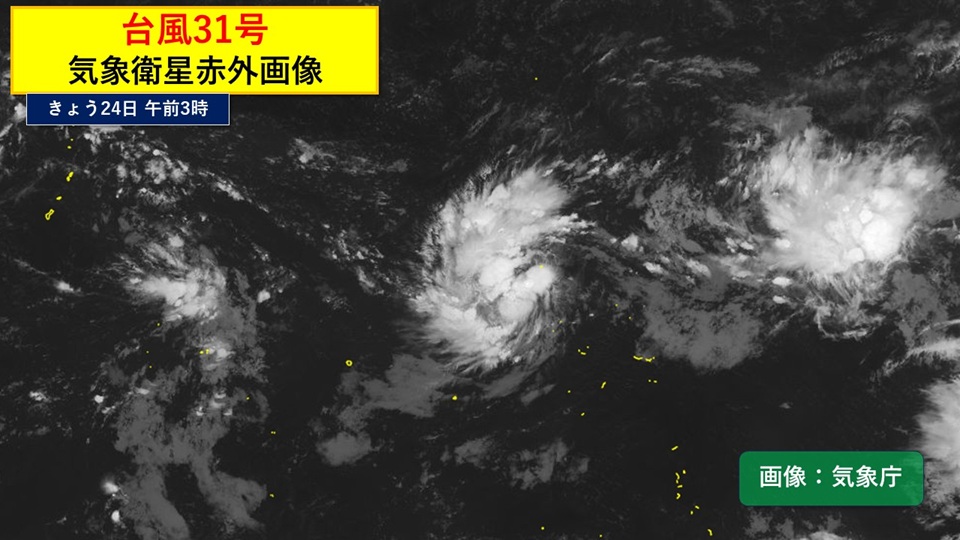
At 3:00 a.m. today, the 24th, a developing tropical depression in the Marshall Islands intensified into Typhoon No. 31. This marks the first time a 31st typhoon has formed since 2013.
? Typhoon No. 31 ? Saturday, the 24th, 3:00 a.m.
==================
Center Location: Marshall Islands
Movement: Southeast, moving slowly
Central Pressure: 1002 hPa
Maximum Sustained Wind Speed: 18 m/s (near the center)
Maximum Gust Wind Speed: 25 m/s
==================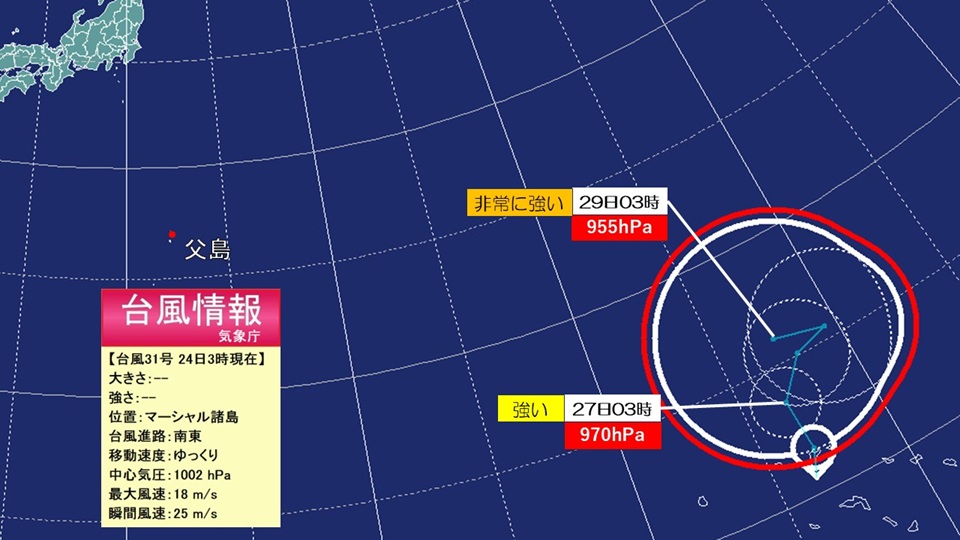
The typhoon is expected to move northward through the Marshall Islands at a relatively slow pace. It is forecast to reach "strong" intensity by Tuesday, the 27th, and develop into a "very strong" typhoon by Thursday, the 29th, while in the vicinity of Wake Island.
Although there is significant uncertainty regarding its subsequent path, the typhoon could potentially affect areas such as the Ogasawara Islands around the beginning of next month, depending on its trajectory. Please continue to monitor the latest typhoon information.
-
Weather for today, Saturday the 24th: Okinawa faces risk of severe weather; rain likely across regions from Tohoku to Kyushu.
2026/10/24 06:47
-
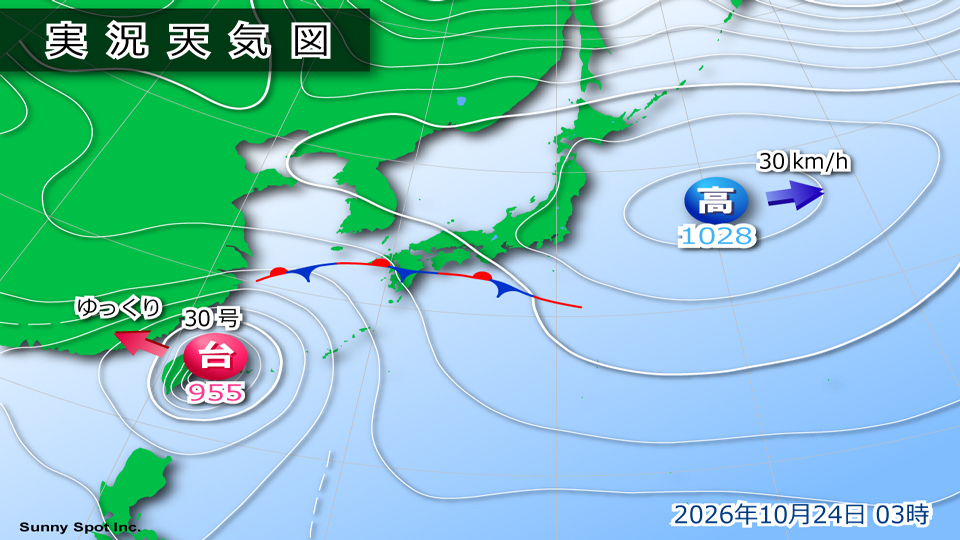
Today, Saturday the 24th, Typhoon No. 30 is expected to move northward across the East China Sea. Meanwhile, a weather front is projected to lie near the main island of Honshu. Consequently, umbrellas will likely be needed across a wide area, stretching from the Tohoku region down to Kyushu. In Okinawa, the typhoon will continue to cause rough weather.
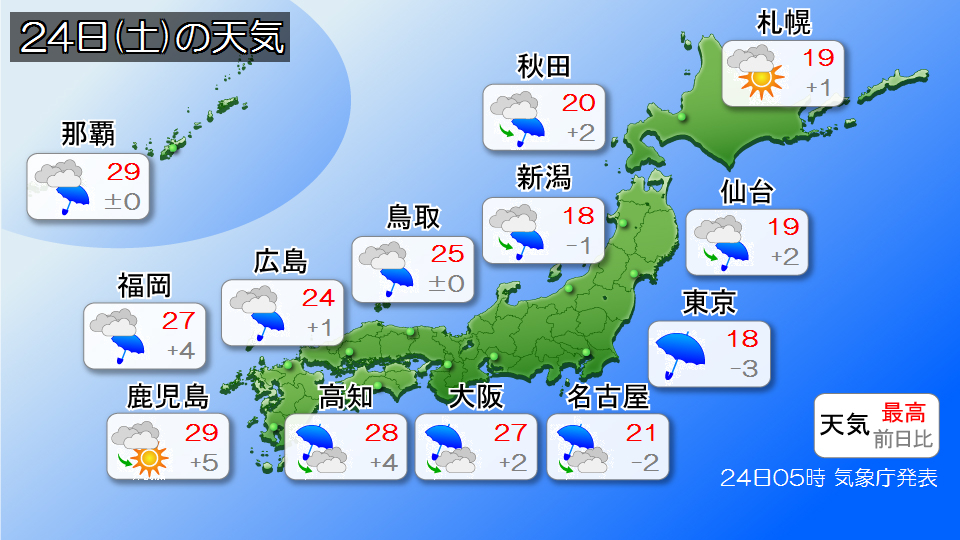
As of 3:00 AM, the large and strong Typhoon No. 30 is nearly stationary northwest of Yonaguni Island, with the Sakishima Islands currently within its zone of violent winds. The typhoon is expected to move northward through the East China Sea; however, its relatively slow pace means that its impact will persist. In the morning, in particular, there is a risk of extremely heavy rainfall?exceeding 50mm per hour?and the Sakishima Islands may experience fierce winds strong enough to potentially cause the collapse of some homes. Residents in Okinawa are advised to avoid non-essential outings and to stay as far away from windows as possible. Please remain on high alert for landslides triggered by heavy rain, as well as potential flooding in low-lying areas and rising water levels or overflowing in rivers.
Along the Sea of ??Japan coast?from northern Kyushu through the San'in region to the Hokuriku region?intermittent rain is expected. Rain clouds are also likely to spread across the Pacific-facing regions of western and eastern Japan, with the potential for localized heavy downpours and thunderstorms. Please be cautious of lightning strikes and sudden gusts of wind.
In the Tohoku region, the weather is expected to deteriorate.
Rain will gradually spread throughout the afternoon, and by nightfall, it is likely to be raining across a broad area. Even if it is not raining when you head out, please be sure to carry rain gear.
In Hokkaido, much of the region will enjoy clear autumn weather, with no significant deterioration in conditions expected. Please be mindful of the temperature difference between the morning/evening and the daytime.
-
Summary of weather and temperatures (October 11–17): Weather followed a cyclical pattern, with significant fluctuations in temperature.
2026/10/23 19:44
-
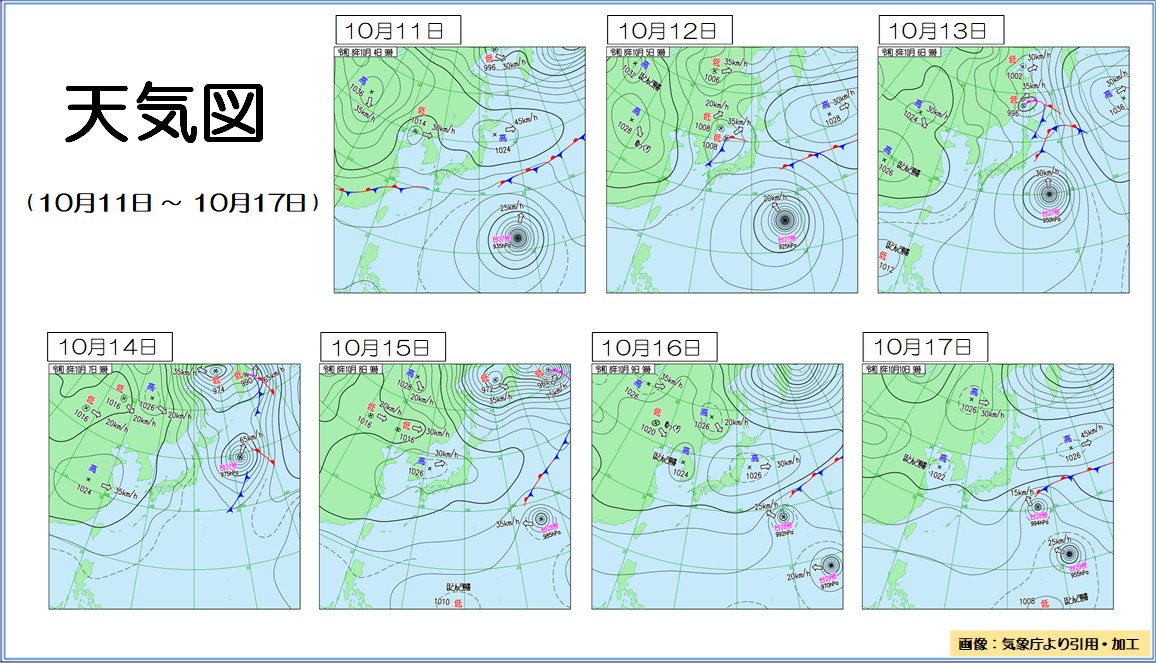
A summary of the weather and temperatures from October 11 to October 17, 2026.
? Atmospheric Pressure Patterns
On the 11th, a pressure trough extended from west of Kyushu to the East China Sea, where a low-pressure system moved slowly northward. Typhoon No. 28 weakened into a tropical depression east of Japan. Meanwhile, a very strong Typhoon No. 29 moved northward near the Ogasawara Islands. On the 12th, a low-pressure system remained nearly stationary over the East China Sea, while the very strong Typhoon No. 29 moved northward from the vicinity of the Ogasawara Islands toward the area east of Japan. On the 13th, a low-pressure system accompanied by a front moved northeastward across the Sea of ??Japan; Typhoon No. 29 continued its northeastward path, moving from the area east of Japan to a position far to the east. On the 14th, a low-pressure system with an associated front intensified while moving north-northeast across the northern Sea of ??Japan, eventually reaching the vicinity of Sakhalin. Far to the south of Japan, near the Marshall Islands, a tropical depression moved slowly northwestward. On the 15th, a "west-high, east-low" pressure pattern (typical of winter-like conditions) prevailed near Northern Japan. Typhoon No. 30 formed near the Marshall Islands and moved westward while intensifying. On the 16th, the "west-high, east-low" pressure pattern persisted near Northern Japan, and Typhoon No. 30 moved westward near the Chuuk (Truk) Islands. On the 17th, a pressure trough existed over the region from North China to South China, situated behind a high-pressure system. A low-pressure system accompanied by a front moved northeastward through Central China.
? Precipitation
On the 11th, very heavy to heavy rainfall was recorded in areas ranging from the Amami region to the main island of Okinawa. Rain also fell intermittently in Kyushu, primarily along the Pacific coast. On the 12th, rain clouds developed near the Southwestern Islands (Nansei Shoto), with heavy rainfall recorded at three locations in Okinawa Prefecture. On the 13th, a cold front moving across the Sea of ??Japan brought rain to Kyushu starting before midday, with precipitation spreading across a wide area of ??western Japan and the Hokuriku region. On the 14th, the cold front caused rain across a large portion of Honshu, with the affected area expanding throughout the afternoon across eastern and northern Japan. On the 15th, cold air in the upper atmosphere led to scattered rain?at times accompanied by thunderstorms?along the Sea of ??Japan coast in northern Tohoku and across Hokkaido. Additionally, a trough of low pressure brought moderately heavy rain to the Izu Islands. On the 16th, as a low-pressure system passed over northern Japan and a cold front moved southeast across the Sea of ??Japan, a band of rain clouds stretched from the Tohoku region to the southern Sea of ??Japan coast, bringing heavy rain accompanied by thunderstorms. On the 17th, a high-pressure system covered much of Honshu, resulting in virtually no significant precipitation anywhere.
? Temperatures
On the 11th, temperatures reached 30C or higher?classified as a "midsummer day"?in some inland areas of Kyushu and the Chugoku region, with some locations recording temperatures 5?7C above the seasonal average. On the 12th, Honshu was under the influence of a high-pressure system, bringing clear skies and sunshine to many areas. In parts of central Hokkaido, the Chubu region, western Chugoku, and northern Kyushu, temperatures were significantly higher than the seasonal average. On the 13th, southerly winds blowing toward a low-pressure system over the Sea of ??Japan caused temperatures to rise along the Sea of ??Japan coast of Honshu due to the Foehn effect. On the 14th, temperatures rose in areas where warm air flowed in from the south; however, following the passage of the front, cold northerly winds moved in, causing temperatures along the Sea of ??Japan coast to rise only slightly from the afternoon onward. On the 15th, many areas from Kyushu to the southern Tohoku region experienced clear, sunny weather. Temperatures reached 25C or higher?classified as a "summer day"?in several locations, primarily along the Pacific coast of western Japan, including a high of 25.4C in Nagoya, Aichi Prefecture. On the 16th, temperatures reached 26.6C in Tokyo, 26.7C in Nagoya, and 25.8C in Osaka?marking "summer days" (temperatures of 25C or higher) across these locations. On the 17th, temperatures dropped below freezing at about five locations in Hokkaido. During the day, however, areas that received sunshine saw temperatures climb above 25C.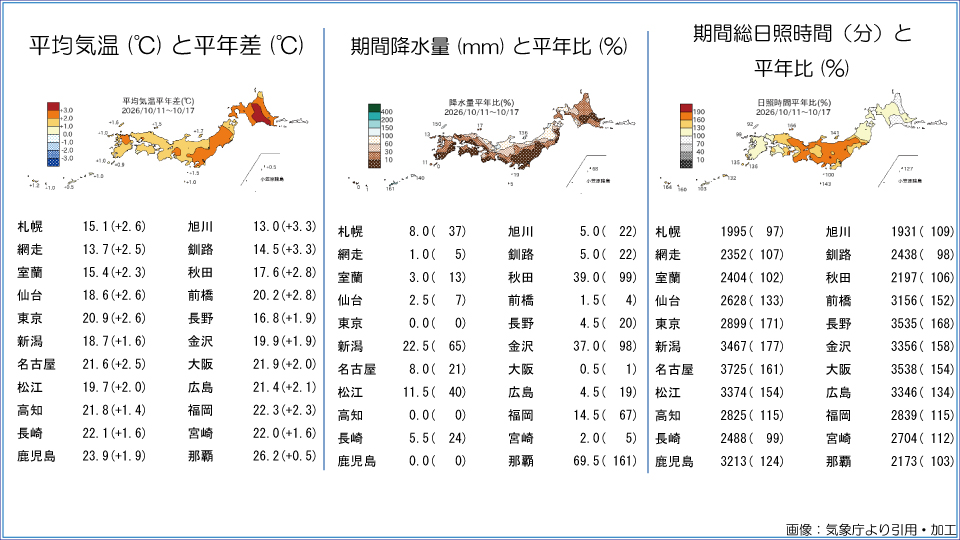
? Weather Summary for the Period (October 11 ? October 17)
Average temperatures across the country were either slightly higher than or above the seasonal norm. Northern Japan, in particular, was frequently covered by warm air, leading to temperatures that were higher than average in many areas. In Hokkaido, locations such as Asahikawa and Kushiro recorded temperatures more than 3C above the seasonal average.
Precipitation was generally below the seasonal norm nationwide, as many areas were under the influence of high-pressure systems; this was especially true along the Pacific coast, where rainfall was significantly lower than average. Conversely, the Southwestern Islands (Nansei Shoto) were more affected by moist air, resulting in rainfall that was slightly above the seasonal average.
Sunshine duration was above the seasonal norm in many areas?particularly across Honshu?due to the frequent presence of high-pressure systems. In the region stretching from the southern part of the Tohoku district to the Kinki district, sunshine duration was more than 1.5 times the seasonal average, with many areas experiencing clear, pleasant autumn weather.
-
[Rain-hit festival alert] A large-scale rock festival is taking place in Izumiotsu, Osaka, this weekend; be prepared for heavy rain brought on by Typhoon No. 30.
2026/10/23 18:47

-
A major rock festival is set to take place this weekend, from Saturday the 24th to Sunday the 25th, in Izumiotsu, Osaka Prefecture. The lineup includes prominent artists known for electrifying crowds at various rock festivals, as well as international acts, making it a highly anticipated local event.
In preparation for this festival in Izumiotsu, we have compiled the local weather forecast for the weekend, along with some tips to help you stay comfortable while attending.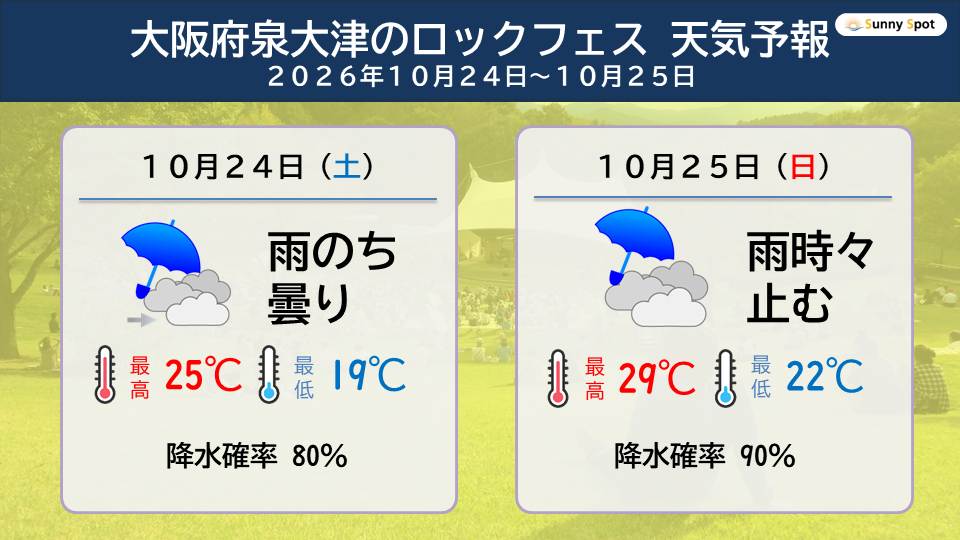
Weather for Saturday, the 24th
On Saturday the 24th, the weather will be rainy, transitioning to cloudy. With a high of 25C and a low of 19C, the rain will make for a rather chilly day.
Tomorrow, the 24th, the area will be affected by a weather front and warm, humid air from Typhoon No. 30. Expect intermittent rain, with the possibility of intense thunderstorms through the late morning. Please be cautious of heavy rain in Izumiotsu during the morning hours. In the afternoon, the rain will ease, with some dry spells expected.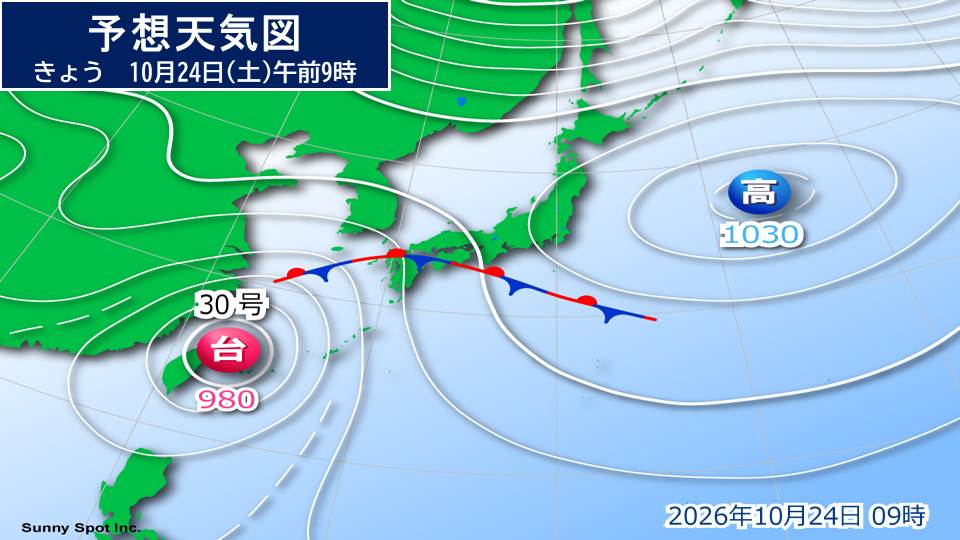
Weather for Sunday, the 25th
On Sunday the 25th, expect rain with occasional breaks; it will generally be a wet day. With a high of 29C and a low of 22C, the weather will feel somewhat muggy.
On Sunday the 25th, as Typhoon No. 30 moves into the East China Sea, the area will be even more susceptible to the influx of humid air. Clouds will spread in from the morning, and intermittent rain is expected to begin in the early afternoon. Rain will intensify from the evening into the night, with the possibility of severe thunderstorms in some areas. As heavy rain is likely during the headlining set, please come prepared with rain gear, such as a raincoat and rain boots.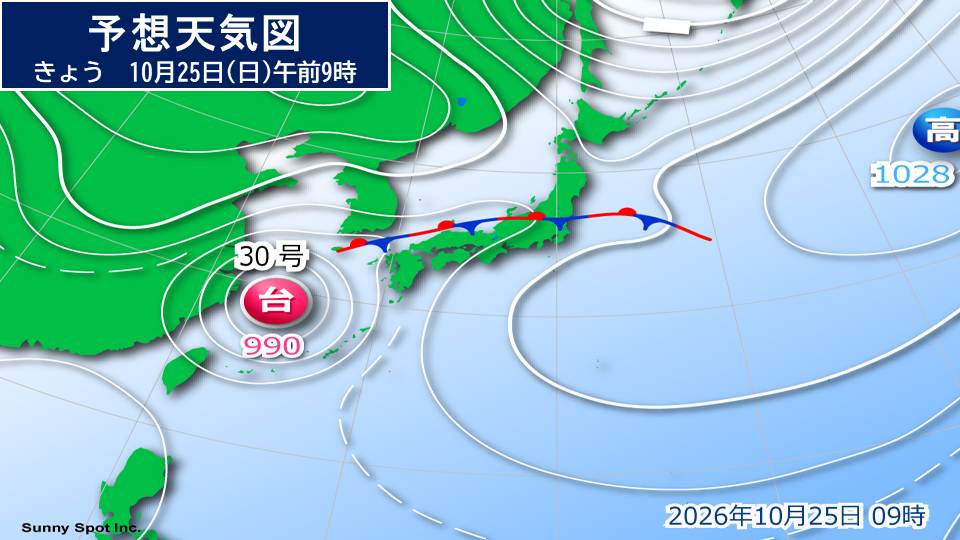
Important Notes for Attendees
Due to the influence of Typhoon No. 30, intermittent rain is expected throughout this weekend.
While there may be periods without rain, heavy downpours are possible?particularly on the morning of Saturday the 24th and the evening of Sunday the 25th?so it is essential to bring proper rain gear, such as a sturdy raincoat, rain boots, or shoe covers.
It is also a good idea to bring a resealable plastic bag (like a Ziploc) to protect valuables such as your wallet and smartphone. You might also consider packing extra socks.
In particular, as heavy rain is possible from the evening of Sunday the 25th onwards, those not attending the after-party following the performance are advised to head home promptly.
Please stay updated with the latest weather forecasts, and take good care of your health so you can have the best possible live music experience!